A field Research Report from East Kalimantan, Indonesia — June 2026
Author: Chengzu Ye
Abstract
Along the Mahakam River in East Kalimantan, Indonesia, two of the country’s largest industries — palm oil and coal — share the same water resource that local ethnic groups rely on for food, livelihoods and cultural identity. Based on 17 cross-village interviews, on-site water quality testing across five sampling locations, and long-term monitoring data released by dolphin conservation NGO RASI, this paper draws a core conclusion: contrary to mainstream overseas perceptions that environmental damage is the primary hazard of palm oil, the most severe harm lies in systematic economic exploitation. Corporations broke promised land profit-sharing clauses, dispossessed indigenous families of ancestral land and trapped residents in irreversible economic reliance. Ecological pollution does exist yet only breaks out episodically and is deliberately concealed by industrial operators. The most profound loss is cultural: a river-centric traditional lifestyle shared by indigenous Dayak and Muslim Kutai peoples is fading away, embodied by the Mahakam Irrawaddy dolphin, whose surviving population has shrunk to merely 66 individuals. Worse still, enterprises mask water contamination and bribe local stakeholders to suppress negative public accounts, making the full scale of damage difficult to expose.
Methodology
This study applied a mixed-methods approach combining qualitative interviews, primary quantitative water testing, and secondary sources.
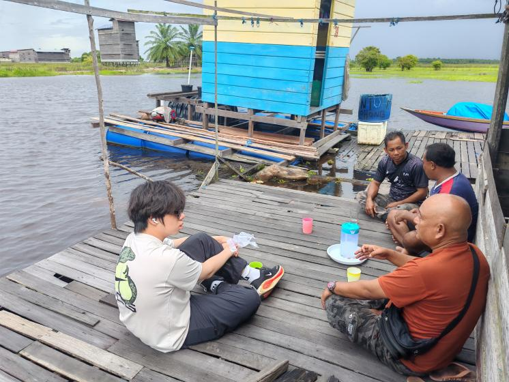
- Interviews. Seventeen audio interviews were recorded between 15–17 June 2026 and transcribed by voice-to-text software. They span a guide-translator, the heads of several palm-oil-affected villages around Tanjung Isuy and Desa Mancong, a retired palm-oil worker and his family, a fisherman in a Muslim fishing village, and several staff of the conservation NGO RASI (Yayasan Konservasi RASI), including its Dutch founder-researcher. Each cited claim below references the recording by date and time code (e.g., Rec. 0615-1351).
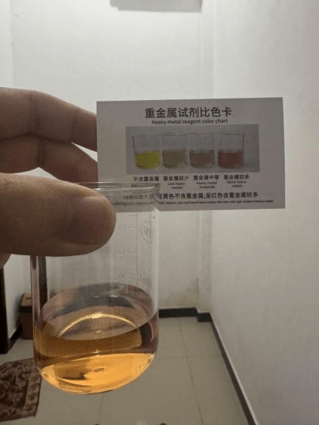
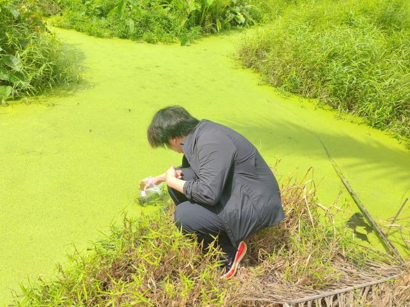
- Water testing. The author tested five river/pond sites between 15–18 June using a self-built microcontroller sensor (temperature, total dissolved solids, turbidity) and a colorimetric reagent kit (dissolved oxygen, ammonia, nitrite, pH, qualitative heavy metals), All test results are benchmarked against Indonesia’s Class II freshwater standards specified in Government Regulation PP No. 22/2021 (Class II).
- NGO reports. RASI’s Pesut Mahakam Monitoring Surveys 2025 and its public materials (ykrasi.org) provided independent, laboratory-grade data on dolphin health and river pollution.
- Secondary sources. Published material on East Kalimantan’s demography, Dayak (Kaharingan) culture, and the palm-oil industry provided context.
- Limitations are addressed in Section 8; the most important are that the interview transcripts are imperfect machine transcriptions (claims are paraphrased, not quoted verbatim), and that the author’s test kit is semi-quantitative and captures only single points in time.
The People and the Place
The Mahakam’s communities are not one people but several. East Kalimantan is roughly 87% Muslim, and the river is lined mostly with Muslim groups — the Kutai (the river basin’s native Malays, themselves descended from Dayak who adopted Islam), the Bugis, and the Banjar — alongside Javanese migrants. The indigenous Dayak, who follow the animist Kaharingan tradition or Christianity, live mainly upriver and in the interior (East Kalimantan and Kutai people, Wikipedia; Forest Peoples Programme 2013). One fishing village visited was essentially 100% fishermen and Muslim (Rec. 0616-1428); the palm-oil villages around Mancong were Dayak (Rec. 0615-1351; 0615-2152).
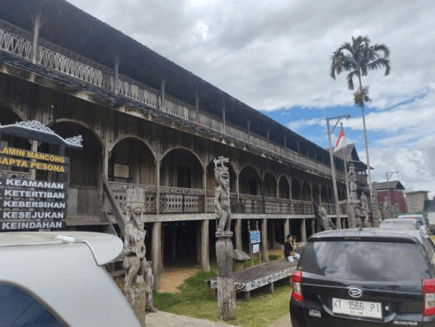
What unites them is the river. About three-quarters of the people in Kutai Kartanegara live rurally, along the Mahakam and its tributaries, depending on it for food, water, and transport. For the Dayak this dependence is also spiritual: as one retired Dayak worker put it, “we Dayak people, we usually unite with nature” — when they clear land they leave the big old trees standing, and they perform rituals offering to ancestor and nature spirits to keep the forest and river healthy (Rec. 0615-2152). This worldview is not taught by any campaign; as a village head explained, the habit of farming gently passes “from father, father, father… because of culture and tradition” (Rec. 0615-1219).
The river’s most famous inhabitant is the Pesut Mahakam, a critically endangered freshwater (Irrawaddy) dolphin found nowhere else in Indonesia. For fishermen it is a living instrument — “if there is a dolphin there, that is the place we can do fishing… it just gives the signal” (RASI, Rec. 0617-1247) — and in regional legend it is sacred, said to be the reincarnation of humans and a guardian of the river (Seasia 2025; Indonesia.travel). RASI counts only 66 left (RASI, Rec. 0617-1215).
1. Palm oil and coal are two of Indonesia’s largest industries, and both reach deep into the rainforests of Borneo’s East Kalimantan
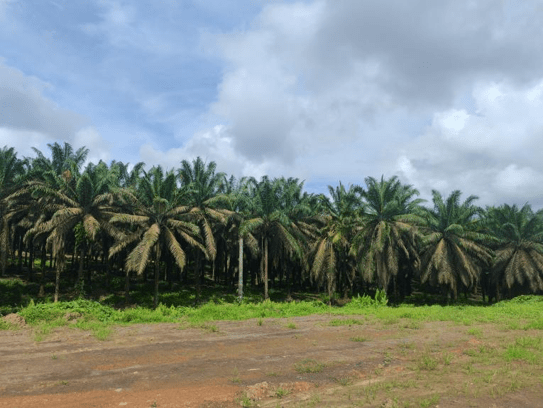
Palm oil ranks among Indonesia’s most pivotal economic sectors, with vast stretches of oil palm plantations sprawling across Borneo’s tropical rainforests (Part A research brief; Murphy, 2025, MDPI Agronomy). The island also contains some of Indonesia’s most abundant coal mineral reserves, with bulk coal transported downstream via river barges through inland waterways. The Mahakam River, East Kalimantan’s vital water artery, cuts through both palm oil plantation zones and coal mining & shipping corridors, running straight through the ancestral homelands of local communities that have subsisted on river resources for hundreds of years.
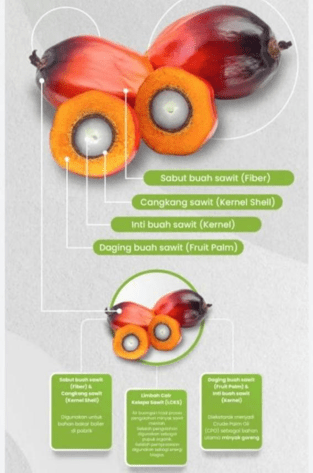
Popular external narratives simplify palm oil into an industrial villain that solely poisons rivers and destroys rainforests. Nevertheless, on-the-ground field investigation delivers a far more complicated, disturbing reality. Under calm, stable hydrological conditions, quantifiable ecological degradation is less serious than the public imagines. In contrast, intangible losses including reduced household income, violated customary land rights, and broken sacred bonds between humans and rivers exert far longer-lasting negative impacts. Enterprises coordinate intentional tactics to make river water look clean and silence aggrieved villagers, jointly covering up all types of industrial harm.
2.Along the Mahakam River live a mix of communities—mostly Muslim Kutai, Bugis, and Banjar, together with the indigenous Dayak—who all depend on the river for food, water, and trade
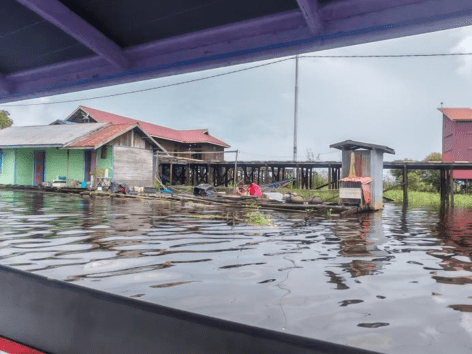
The Mahakam River basin is inhabited by diverse ethnic groups rather than a single unified population. Approximately 87% of East Kalimantan’s residents identify as Muslim; riverside settlements are mainly occupied by Kutai people — indigenous Malay descendants of Dayak communities that converted to Islam — alongside Bugis, Banjar groups and Javanese migrant workers. Indigenous Dayak peoples, who practice Kaharingan animism or Christianity, mostly reside in upstream inland forest areas (“East Kalimantan and Kutai people”, Wikipedia; Forest Peoples Programme 2013). During field visits, one fishing village consisted entirely of Muslim fishers (Rec. 0616-1428), while villages surrounding the Mancong palm oil plantations were dominated by Dayak households.
The river acts as a shared lifeline connecting all ethnic groups. Around three-quarters of residents in Kutai Kartanegara Regency live in rural riverside villages along the Mahakam and its tributaries, relying fully on the waterway for food, domestic water and cargo transportation. For Dayak people, reliance on the river carries profound spiritual connotations. As one retired Dayak plantation worker stated: “we Dayak people, we usually unite with nature.” During land clearance for farming, locals preserve ancient mature trees and hold sacrificial rituals to worship ancestors and natural spirits to maintain forest and river health (Rec. 0615-2152). Village heads explained such mild, eco-friendly farming traditions are passed down generation after generation through cultural inheritance instead of external advocacy campaigns (Rec. 0615-1219).
The basin’s most iconic species is the Pesut Mahakam, a critically endangered Irrawaddy dolphin endemic exclusively to Indonesia. For fishers, dolphins serve as natural fishing indicators: “if there is a dolphin there, that is the place we can do fishing… it just gives the signal” (RASI, Rec. 0617-1247). Regional folklore regards dolphins as sacred reincarnations of humans and permanent river guardians (Seasia 2025; Indonesia.travel). RASI’s population surveys confirm merely 66 wild dolphins remain in the basin (RASI, Rec. 0617-1215).
3.Economically, palm oil traps many local farmers in a dependency they cannot escape—companies give out seedlings, become the only buyer, and crash the price until families sell at a loss
Systematic economic exploitation is the most consistent complaint collected from every palm oil village, rooted in corporations’ broken land profit-sharing pledges. Enterprises began expanding into local villages as early as 1993, with large-scale forest clearance launched in 1997 (Rec. 0615-1337). They promoted a local cooperative policy named the “plasma scheme”, promising to reserve roughly 20% of acquired land or corresponding harvest yields for indigenous landowners. In reality, this commitment was never fulfilled. An elder of Mancong Village recounted enterprises seized all plantation land without reserving any share for locals (Rec. 0615-1351); a retired worker whose family surrendered 200 hectares of ancestral land also confirmed no promised land allocation was ever delivered (Rec. 0615-2138). Identical grievances appeared across four independent interview recordings, and RASI’s founder validated this two-decade exploitative pattern, stating indigenous residents receive zero tangible benefits under the plasma scheme (RASI, Rec. 0617-1658).
The unfair contract framework is the root cause of broken promises. Corporations only provide one-off lump-sum land compensation, with no contractual clauses granting villagers permanent shares of long-term industrial profits (Rec. 0615-1351; 0615-2152). After land transfer, residents lose all future revenue streams, even as enterprises achieve full-cycle processing and profit maximization of palm fruits (Rec. 0615-2233). When villagers demanded compliance with the 20% agreement, corporations instructed them to develop new land independently — an impossible demand due to insufficient capital and inaccessible official permits, leaving residents trapped with no viable options (Rec. 0615-1513).
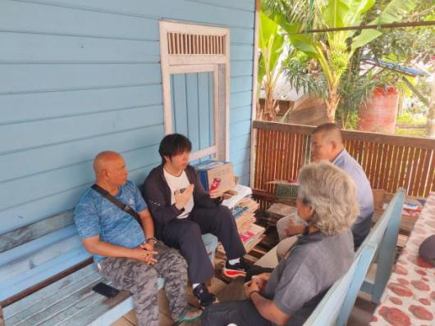
Farmers who chose self-managed palm cultivation fell into a second debt trap. Enterprises provide seedlings and fertilizers on credit, forcing growers to sell all harvested fruits exclusively to the firm as the sole purchaser (RASI, Rec. 0617-1658). Oversupply continuously suppresses crop prices to 4–5 million rupiah per hectare, leaving farmers forced to sell products at a loss with no pricing power. The NGO supervisor compared this operational logic to predatory transnational food conglomerates. Worse, households refusing land acquisition reportedly suffered overnight arson that destroyed all trees and crops, rendering them penniless (RASI, Rec. 0617-1658).
Promised employment also failed to offset income losses. Palm harvesting involves gruelling, unfamiliar labour that locals cannot sustain long-term, while well-paid assistant and managerial positions are reserved for Batak migrant workers from Sumatra (Rec. 0615-1351). Wages gradually declined over decades: a 28-year industry veteran who once supervised 200 harvesting staff stated corporations eliminated overtime and bonuses under the guise of operational efficiency, dragging salaries below regional average levels and stripping the occupation of social prestige (Rec. 0615-2152). In one village, the employment rate of working-age adults dropped from 80–90% pre-industrialization to approximately 30%. RASI data records a 50% revenue decline for fishing communities during palm waste overflow pollution incidents (RASI, Rec. 0617-1649). Overall, economic deprivation is the most thoroughly verified harm in this research.
4.Environmentally, the plantations and mills erode the soil and foul the rivers, until water that people once drank straight from is no longer safe
Palm oil mills generate thick industrial waste locally called “Miko”, impure residual oil stored in large earthen lagoons intended for farm fertilization (Rec. 0615-2138; 0615-2223). However, waste accumulation outpaces land absorption capacity, and lagoons overflow during heavy rainfall, discharging massive toxic effluent directly into rivers (Rec. 0615-2223). A retired worker recalled a maintenance accident where a bulldozer ruptured waste pipelines and contaminated a nearby lake selected for water sampling. Large-scale deforestation for plantations also intensifies soil erosion and flooding: bare plantation land cannot retain rainwater like native forests, and sediment-laden runoff turns river water murky coffee-brown (Rec. 0615-1519).

Multiple villagers described identical ecological deterioration: the river once safe for direct drinking now can only be used for washing; water frequently turns black and muddy, accompanied by mass fish die-offs (Rec. 0615-1219; 0615-1351; 0615-2152). A catastrophic lagoon leakage triggered widespread fish mortality around 2002, while another overflow event in 2024 collapsed fish stocks across two fishing villages (Rec. 0615-1519; RASI, Rec. 0617-1649). Notably, local communities have never conducted formal water testing and rely solely on dead fish to judge water toxicity (Rec. 0615-1351).
Author’s single-point sampling created an obvious data gap compared with resident testimony. Natural river segments including Kunut, Ohang, Mayan and the coal terminal feature soft weakly acidic peat water with negligible heavy metals, while the Uyur factory waste lagoon is the sole outlier: TDS reaches 414 ppm (12 times natural river levels), pH rises to neutral 7.2 and heavy metals severely exceed standards. Dissolved oxygen fails Class II criteria at Kunut and downstream Ohang sites. Basic testing kits cannot capture invisible hazards including organic pollutants, floating oil and airborne dust, meaning pollution only emerges during rain-driven overflows — the ecological disasters witnessed by downstream villagers. RASI’s quarterly long-term monitoring supplements this limitation, detecting copper, lead and cadmium washed off plantations alongside coal contaminants; 2025 surveys identified toxicants and microplastics in dolphin tissue, with a male dolphin named Upin confirmed dead from chemical poisoning rather than drowning, forming a complete pollution chain from factory waste to the basin’s sacred aquatic species.
5.Palm oil is not even the only industry crowding these rivers, the coal leaves ash that blackens the river’s surface and sickens the fishermen’s lungs, so the Mahakam now carries the weight of two industries at once
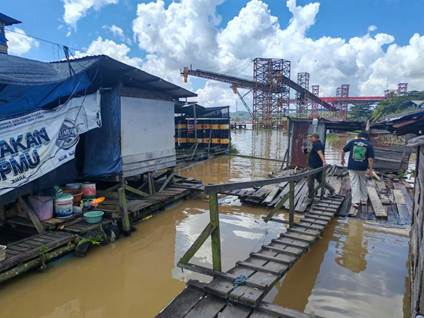
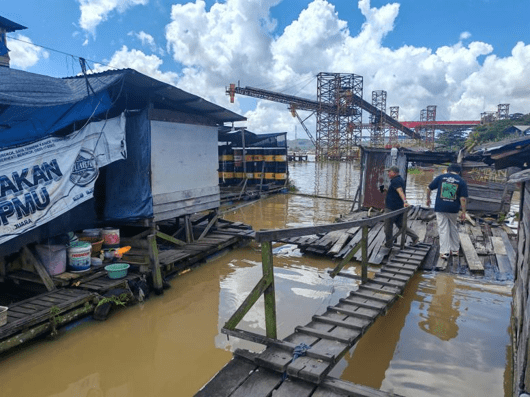
Coal mining and shipping bring compound pollution superimposed on palm oil contamination. Fishers at coal transshipment terminals reported coal ash covering the water surface and triggering persistent respiratory discomfort, with polluted runoff from upstream palm plantations compounding local water degradation. Uninterrupted barge traffic severely disturbs dolphin habitats, with one coal pontoon passing every five minutes and shipping volume growing year by year (RASI, Rec. 0617-1226). RASI’s monitoring linked an April 2025 surge of copper and cadmium in river water to peak large vessel traffic; copper leaches from ships’ anti-fouling paint under freshwater conditions, and metal concentrations drop immediately after shipping volume subsides (RASI, Rec. 0617-1658). While chemical indicators at coal terminals meet standards, invisible airborne coal dust and floating ash cannot be detected by conventional water testing kits. The Mahakam River bears dual pollution pressure from palm oil plantations and coal transportation simultaneously.
6. These rivers are not only a livelihood but a sacred inheritance, and every community along the Mahakam reveres its holy river dolphin, the Pesut Mahakam
The Mahakam River is far more than a source of food and income; it constitutes a shared sacred heritage for all riparian ethnic groups. The Pesut Mahakam dolphin serves as a cross-community cultural symbol, revered as river guardian spirits in local folklore and practical navigation markers for fishers. The sharp decline of its population to only 66 individuals brings collective grief to both Muslim Kutai fishing communities and indigenous Dayak groups.
7. For the indigenous Dayak the wound cuts deepest, because their tradition is built on living in harmony with the spirits of the forest, the land, and the river
For Dayak peoples, land and rivers are not exploitable natural resources but eternal spiritual bonds. Their Kaharingan animist tradition advocates harmonious coexistence with forest, land and water spirits, protected by indigenous customary law (adat). Academic research confirms Dayak self-managed forests deliver superior conservation outcomes compared to corporate or state development (Borneo Nature Foundation; Mongabay 2024). Palm oil plantations completely sever this ancestral connection. RASI’s founder stated loss of ancestral land erodes the core identity of Dayak communities (RASI, Rec. 0617-1658). Native forests that once supplied wild game, timber and medicinal plants have disappeared, with wild pigs and deer rendered regionally extinct — a direct destruction of indigenous cultural traditions (Rec. 0615-2152). During field surveys, virtually no native wildlife could be found across fully converted oil palm landscapes (RASI, Rec. 0617-1732).
Cultural damage is shared across ethnic groups with differentiated impacts: land-based Dayak communities suffer first from land dispossession, while 95% fishing-reliant Kutai Muslim villages bear the brunt of polluted river runoff (RASI, Rec. 0617-1658).
8.As these industries poison the river, that sacred dolphin has fallen to only sixty-six — a loss felt by Muslim and Dayak alike
Continuous dual pollution from palm oil and coal poisons the entire river ecosystem, accumulating toxic substances up the food chain and directly threatening the survival of the Pesut Mahakam dolphin, Indonesia’s endemic freshwater cetacean. Its population has dwindled to merely 66 individuals. Whether Muslim fishers who rely on dolphins to locate fish stocks or Dayak peoples who view the river as a sacred spiritual territory, all basin residents share the grief of losing this sacred cultural icon. This wildlife decline symbolizes the overall collapse of the river-centred traditional civilization.Why is this harm so hard to see and to stop?
9.The harm is hard to see, because companies hide the pollution — dosing the rivers with chlorine so the water looks clean while the fish keep entering
Enterprises adopt systematic camouflage tactics to conceal water contamination. Senior RASI researchers confirmed corporations discharge lime and chlorine into polluted river segments solely to improve visual transparency, ignoring toxic substances remaining in the water column (RASI, Rec. 0617-1649). The author recorded a neutral pH of 6.5 at one sampling site, while RASI long-term monitoring registered extreme alkalinity of 8.5 in Ohong Village’s river water — corrosive enough to erode metal overnight and comparable to seawater in harshness. Visually clear water does not equal ecologically safe water, and fish mass mortality persists despite artificially brightened river appearance.
10.It is hard to stop, because the companies hold far more money and power than the villagers, have bribed officials, and have even paid some village leaders to call palm oil good
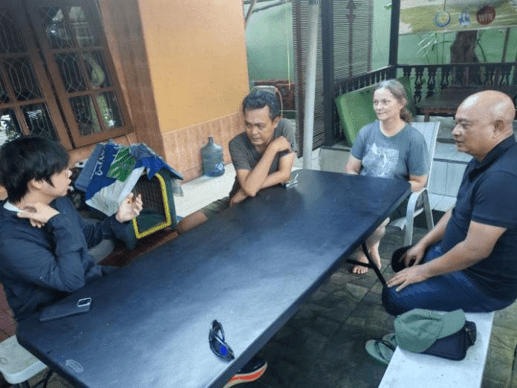
Multiple power barriers block residents from stopping industrial harm. First, widespread bribery distorts community testimony: two village heads publicly praised palm oil development, conflicting with mass resident complaints. RASI explained many village leaders accept corporate hush money to suppress criticism, splitting villages like Muara Siran into opposing factions of bribed and uncompensated residents (RASI, Rec. 0617-1658). Second, regulatory capture hollowed out law enforcement: after pollution incidents, enterprises resolve government inspections through informal cash payments to inspectors (Rec. 0615-2223). Locals summarized the regional rule as wealth equalling authority. Plantation and coal permits are issued by central government, leaving local officials without enforcement power; even officially designated 2022 protected areas hosted coal stockpiles and barge shipping by 2023 under central mining licences (RASI, Rec. 0617-1649). Third, communities lack legal recourse: residents hold land through ancestral oral inheritance without formal state land certificates, unable to launch lawsuits for land protection (RASI, Rec. 0617-1658).
11. In the end, these industries cost the people of the Mahakam not only their income, but their rivers and the sacred world they have lived inside for generations
Dayak peoples trust verbal agreements while corporations operate exclusively via legal contracts to evade accountability. Residents also rely economically on local palm and coal industries; during the 2002 fish die-off disaster, they avoided formal complaints for fear of industrial retaliation (Rec. 0615-1519). RASI criticized the inverted local development logic that prioritizes economic growth over ecological protection, with government agencies only launching remedial measures after catastrophic disasters with no proactive prevention mechanisms.
Palm oil and coal operations act as overlapping systemic threats along the Mahakam River, jointly eroding river ecosystems and the livelihoods of Kutai Muslim, Bugis and indigenous Dayak communities. Industrial damage follows a clear hierarchical structure: economic exploitation is the most tangible harm, as corporations broke the 20% land-sharing pledges and constructed multi-layered debt traps to seize ancestral land with minimal reciprocal benefits. Environmental contamination is real yet sporadic, triggered by waste lagoon overflows and peak coal shipping; independent laboratory data verifies toxic bioaccumulation endangering the iconic Mahakam dolphin. Cultural erosion represents the most enduring loss, manifested by the collapse of river-centred traditional lifestyles, regional extinction of native forest wildlife and the near-disappearance of a dolphin species sacred to all riparian residents.
All three tiers of harm stem from structural power imbalance and systematic information concealment: enterprises chemically treat water to create an illusion of cleanliness; village leaders accept corporate bribes; mining and plantation permits are controlled by distant central authorities; indigenous residents lack formal land titles to defend their homelands. The greatest difficulty encountered during fieldwork was not water quality measurement, but penetrating manufactured narratives designed to cover up industrial damage.
This research delivers a core insight: the most profound adverse impacts of industrial development often cannot be quantified by testing instruments. Comprehensive industrial impact assessment requires consistent quantitative environmental monitoring paired with empathetic listening to unmeasurable resident oral histories and intangible cultural trauma.
Conclusion
Along the Mahakam, palm oil and coal are not a single villain but a crowd of them, pressing on one river and on the communities — Muslim Kutai and Bugis, indigenous Dayak — who depend on it. The harm they do is economic first and most clearly: a broken twenty-percent promise and a debt trap that took families’ land and gave little back. It is environmental in a real but episodic way — a waste pond that poisons the river when it overflows, a heavy-metal pulse that the author’s own kit caught only at its source while RASI’s laboratory traced it all the way into a dying dolphin. And it is cultural most deeply of all: the quiet unravelling of a sacred, river-centred way of life, marked by the disappearance of the forest’s game and the near-extinction of a dolphin that an entire river holds holy.
Underlying all three is a problem of power and visibility. The water is dosed with chlorine to look clean; village leaders are paid to call the industry good; the permits are held far away in the capital; and the people who pay the price have no certificate to their own land. The hardest part of this research was never measuring the water. It was seeing the truth at all, through the stories built to hide it. The most important conclusion is therefore also the most humbling: that the deepest harms of development are often the ones no instrument records — and that to understand them, one has to keep measuring what can be measured, and keep listening for everything that cannot.
Limitations
Readers must interpret this study’s conclusions with full awareness of inherent research constraints. Automated interview transcripts contain minor recognition errors, so all resident statements are paraphrased instead of verbatim quotations. The portable water testing kit only supports semi-quantitative analysis and captures instantaneous snapshot data, unable to reflect long-term seasonal fluctuations or detect palm effluent’s core pollutants including BOD, COD and floating oil. Key allegations such as chlorine pollution masking, village leader bribery and corporate farm arson rely primarily on RASI’s testimony, constituting well-supported circumstantial claims rather than fully verified objective facts. Contradictory positive accounts from village heads and negative resident/NGO evidence are treated as a core research phenomenon rather than arbitrarily prioritizing one narrative over the other.
References
Interviews (field recordings, East Kalimantan, June 2026)
- Rec. 0615-1154 / 0615-1219 — Village head, palm-growing village near Tanjung Isuy (Jempang Lakes), with guide-translator. 15 Jun.
- Rec. 0615-1337 — Dayak village elder, on PT Lonsum (London Sumatra) and the broken 20% promise. 15 Jun.
- Rec. 0615-1351 — Desa Mancong (Dayak), village head and villagers; plasma scheme, pollution, governance. 15 Jun.
- Rec. 0615-1513 — Local informant, on the 80/20 plasma scheme. 15 Jun.
- Rec. 0615-1519 — Village leader, on the ~2002 fish die-off and lagoon leak. 15 Jun.
- Rec. 0615-2138 / 2152 / 2223 / 2233 — Dayak family (husband, 28 years in palm oil; wife, Banjar teacher); contracts, mill waste flow, byproducts, Dayak culture. 15 Jun.
- Rec. 0616-1428 — Fisherman (b. 1983), Muslim fishing village (~200 people). 16 Jun.
- Rec. 0617-1215 / 1226 / 1247 — RASI staff/guides; dolphin population (66), pollution, barge traffic, eco-tourism, weak government support. 17 Jun.
- Rec. 0617-1649 / 1658 / 1732 — Senior RASI conservationist and Dutch founder-researcher; chlorine/lime masking, debt trap, burned fields, ethnic impacts, heavy-metals monitoring (Cu/Pb/Cd), April 2025 antifouling-paint spike, bribed leaders, the proposed dam, NGO structure and funding. 17 Jun.
NGO reports
- RASI (Yayasan Konservasi RASI), Pesut Mahakam Monitoring Surveys 2025 — heavy metals (copper), pesticides, toxins and microplastics in dolphin tissue; death of dolphin “Upin” from toxic exposure; 43,000-ha protected reserve.
- RASI public materials, ykrasi.org.
Primary data
- Author’s water-quality sampling, five sites, 15–18 June 2026 (sensor + reagent kit), benchmarked to PP No. 22/2021 Class II.
Secondary sources
- “East Kalimantan” and “Kutai people,” Wikipedia.
- Forest Peoples Programme (2013), PT REA Kaltim Plantations and the Dayak and Kutai Peoples of Kutai Kartanegara.
- Borneo Nature Foundation, “Demystifying the conservation value of Dayak sacred forest”; Mongabay (2024–2025), Dayak forest defence.
- “The Legend of the Mahakam Dolphin,” Seasia (2025); “Sungai Mahakam,” Indonesia.travel.
- Murphy, D. (2025), MDPI Agronomy 15(6):1465; and the author’s Part A research brief on Indonesia’s palm-oil industry.
Table 1 — Water-quality results (Author’s sampling, 15–18 June 2026; benchmark: PP 22/2021 Class II)
| Parameter | Kunut | Ohang | Mayan | Uyur (factory pond) | Mahakam (coal site) | Class II |
| Dissolved O₂ (mg/L) | 2 ✗ | 3 ✗ | 6 ✓ | 5 ✓ | 3.5 ✗ | ≥4 |
| pH | 6.04 | 5.58 | 5.77 | 7.2 | 6.73 | 6–9 |
| TDS (ppm) | 28 | 25 | 37 | 414 | 24 | ≤1000 |
| Ammonia (mg/L) | 0.2 | 0.2 | 0.2 | 0.2 | 0.2 | ~0.2 |
| Nitrite (mg/L) | 0.005 | 0.005 | 0.005 | 0.005 | 0.005 | ≤0.06 |
| Heavy metals | low | low | none | severe ✗ | low | trace |