Authors: Gu Hengyu, Wang Luoqing, Yan Zimo
Grameen Bank originated from a simple idea by Nobel Peace Prize laureate Professor Yunus—that the poor could obtain life-changing loans without collateral. The key to its model’s ability to maintain high repayment rates while serving the poor without requiring collateral lies in the establishment of a risk control system that differs from that of traditional banks.
The risk control systems of traditional banks make it difficult for rural women to obtain loans. Traditional banks’ risk control systems require strict scrutiny of borrowers’ financial status, credit history, and collateral. Under this model, rural women often struggle to pass bank reviews due to a lack of proof of stable income, assets to pledge as collateral, and a well-established credit history, making it difficult for them to secure loan support within the traditional system. Yanqiu Wang from Lukou Village shared: “Banks won’t lend to us. They require guarantors—five of them, in fact. If you can’t repay the loan, the guarantors have to pay it back.”
In contrast to banks, the Grameen model provides loan support to impoverished groups without requiring collateral. Under these circumstances, the model maintains a high repayment rate, thanks to Grameen’s unique risk management system. As Ms. Zhu, manager of the Grameen China Center, explained: “Compared to our domestic system—where if you fail to repay, even if it’s just one yuan short, I have to report it to your credit bureau—it’s actually completely different. That’s why it has such a large membership base and such a high repayment rate. … The repayment rate is 99 percent.”
The Grameen model does not rely on collateral to mitigate risk; instead, it gradually disperses and mitigates risk at every stage—before, during, and after the loan—through screening and vetting, mutual oversight among community members, and continuous empowerment. Ms. Zhu mentioned that the system relies more on “care between people, through helping borrowers overcome difficulties,” rather than external pressure or punishment mechanisms in the traditional sense. This support is “a lifeline in times of need.”

Preventing Lending Risks Through Group Consensus
First, Grameen places risk control before loans are issued, using personal connections, training attendance, and community reputation to screen out trustworthy borrowers at the source.
Trust is the first threshold for joining a group. At Grameen, risk control begins the moment a member is sought out—Grameen requires that five-person groups consist of voluntarily formed members, all of whom must come from the same community, know one another, and trust one another. Aunt Ding put it simply and clearly: “If these people didn’t have some sense of trust, could you easily bring this one person into the group to take out a loan?”
One criterion for mutual trust is an understanding of each other’s financial circumstances. Zhu Qing described this process: “You voluntarily become a member of this group based on your trust in the other members. So what does that trust rest on? First, her family’s financial situation—you recognize that she’s capable of repaying the loan alongside you.” Aunt Ding also emphasized: “How could you form a group if you didn’t know each other?” “Everyone here is a neighbor… people you can talk to and who’ll talk back.”
Therefore, Grameen shifted the credit screening—which was originally the bank’s responsibility—to the member groups, replacing credit reports with the familiarity and understanding inherent in a community of acquaintances.
The five-day pre-loan training is also a crucial screening step. Yanqiu Wang noted, “When we first started the training, it was precisely because we were punctual and trustworthy that they granted us the loans.” If a potential borrower cannot even stick with the training, they naturally won’t be included in the loan system.
Community reputation serves as another crucial filter. Member Aunt Ji Shuyan put it this way: “Since we’re all from nearby villages, we know each other pretty well, and those with good credit… If someone has a bad reputation and comes to apply for a loan, you’d tell the staff right away… If they come to a meeting, the first requirement is that they complete a week of training—and they might not even be able to stick it out.”
Yanqiu Wang expressed a similar view: “If a ne’er-do-well or someone who doesn’t work hard in our village comes to apply for a loan, we (the five-person group) definitely won’t approve it. Since we’re all from nearby villages, we know each other pretty well. We all know who has good credit.”
The intricate network of information in rural society allows members to understand each other’s “financial situation” better than banks do, thereby effectively reducing the risk of bad debt.
Through multiple screening methods—including referrals from acquaintances, community reputation assessments, and observation of training attendance—Grameen completes a precise identification of borrowers before loans are disbursed. Impoverished women with no credit history but a good reputation in the community, who have genuine business needs and are willing to follow the rules, are admitted into the Grameen system; while those with poor credit or a lack of willingness to repay are excluded at the source.
Zhu Qing summarized: “They must have formed a new group through self-screening and mutual vetting. This group actually serves as a manifestation of our risk control—that is, risk control through the collective.” This logic of upfront risk control significantly moves the risk management checkpoint forward, laying a solid foundation for the subsequent high repayment rates.
Managing Risk Through Decentralized Group Oversight
Under the Grameen model, loan repayment relies on soft constraints such as public oversight, experience-sharing, and community mutual aid to ensure compliance, rather than pressure from debt obligations. This decentralized, distributed approach to risk control also significantly mitigates risk.
First, in the Grameen model, the open oversight mechanism is a crucial component of risk control. Group leaders and center directors exercise a certain degree of oversight over the use of funds to ensure that loan funds are not misused, thereby reducing risk at its source. Ms. Zhu shared the experience of Grameen staff on this point: “When we pass by a member’s home, everyone can see what kind of livelihood they’re engaged in. This kind of oversight is also a form of risk management.”
The reason this risk control mechanism functions effectively in villages is also related to the highly familiar community structure in these areas. Since villagers have lived in the same geographical area for a long time, information among them is highly transparent, and risk assessment is largely carried out naturally through understanding and judgment gained from daily interactions.
In the minds of rural women, borrowers are already part of a social network visible to acquaintances; their choices and judgments do not rely on external scrutiny but are based on long-term, everyday familiarity. As Yanqiu Wang mentioned in an interview: “We’re all from the same village; we know each other so well… Most are from our village. Our village’s choices are our own.”
At the same time, the public repayment mechanism implemented during weekly meetings further reinforces this decentralized management approach. The repayment process requires step-by-step verification and confirmation by the group leader and the center manager. Under the joint supervision of multiple parties, the entire repayment process becomes more open and transparent, thereby reducing risks arising from information asymmetry or abuse of power.
Second, the sharing of experiences among group members provides soft support for members’ entrepreneurial success. During the group’s weekly meetings, members exchange insights on how to run a business, how to make repayments, and how to resolve problems they encounter, using each other’s experiences to help one another manage their businesses and make repayments more effectively.
Finally, voluntary mutual aid within the group helps resolve crises when individual members are temporarily unable to make timely repayments. Aunt Ding commented on this, saying, “If someone can’t make a payment due to special circumstances, we can help out. I’ll cover it for them, and they’ll pay me back in a couple of days.”
Long-Term Empowerment Mitigates Long-Term Risks
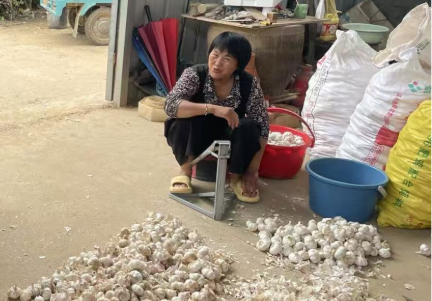
Through democratic governance, support for self-employment, and training in savings, education, and health, Grameen continuously enhances borrowers’ income-generating capacity and resilience to risks.
In terms of democratic governance, Grameen members are not merely borrowers; they are also the owners of the organization. “Of the 13 members on Grameen’s board of directors, nine are our members. Yunus holds zero shares in Grameen,” a Grameen staff member shared.
Grameen also grants its members full autonomy. Decisions regarding who can join a group and who receives loans are made at meetings of the five-member groups and at center meetings, without the need for approval from Grameen center staff.
“A Grameen center manager is responsible for 500 members. Without fully empowering the members and motivating them, this would be impossible,” Zhu Qing told us.
In terms of self-employment support, Grameen Bank encourages members to leverage their own strengths to start businesses, using weekly meetings as a platform for members to exchange business skills and market information.
“Unlike traditional banks, we don’t advise members on which industries to enter. Instead, we fully tap into their inherent abilities and strengths, enabling them to scale up their ventures,” Gao Zhan shared.
Ms. Bai Guanying said, “At our weekly meetings, we discuss what to plant and what the purchase prices are, to avoid selling at low prices and incurring losses.” This simple and direct exchange of information is very practical for rural women who lack market information—knowing when to sell and at what price directly affects their income.
In Bangladesh, there are even Grameen vocational training schools offering courses in English, sewing machine repair, design, motorcycle repair, and computer repair. A new cohort of trainees completes the program every three to four months, after which the school helps them find employment. These skills training programs provide members and their families with the opportunity to secure more stable sources of income, rather than relying solely on a few mu of farmland.
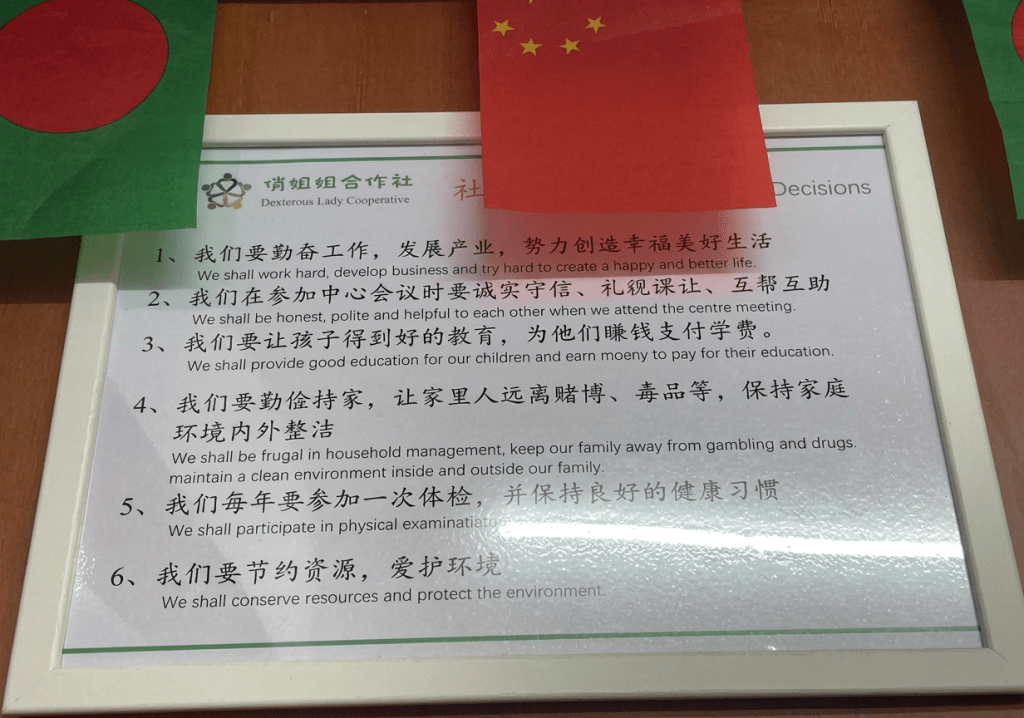
In terms of savings, education, and health training, Grameen helps members manage their household finances through “Sixteen Decisions” and mandatory savings, thereby reducing the impact of unexpected large expenses.
Grameen also requires members to set aside a portion of their repayment as savings each time they make a payment. By saving a little each week, they accumulate a sum by the end of the year that can be used for major expenses such as their children’s education or medical bills, and they also receive dividends.
In addition, Grameen has sixteen covenants that serve as a consensus among members, covering all aspects of a better life. For example, the covenants on education state, “Do not let children drop out of school; earn money to pay for their tuition”; those on environmental hygiene require the use of clean and sanitary toilets and planting trees every year; and those on personal health mandate annual physical examinations.
These covenants represent the most important aspects of improving their lives, as identified by Grameen in collaboration with its members. “There are so many problems in the lives of the poor that they don’t have the time to deal with them all. Grameen helps people understand what to prioritize so they can gradually get their lives back on track and escape the trap of poverty.”
As individuals and families become increasingly resilient to risks, borrowers’ ability to repay becomes more stable, and loan risks are mitigated at the source.
Helping members live better lives is, in itself, the best form of risk control.
Grameen empowers members so they can run their businesses successfully and manage their households effectively, rather than simply “lending money and praying it will be repaid.”
Conclusion
Grameen’s risk management is not carried out as a standalone process at a specific stage, but is integrated into every daily interaction.
From the perspective of Grameen staff, seemingly ordinary actions—such as visiting villagers’ homes, briefly stopping by their houses while passing through the village entrance, or even everyday conversations and interactions—are all part of the ongoing process of gathering post-loan information. As Ms. Zhu put it: “Every time we, for example, go to your home for a meal… or pass by your house at the village entrance—these actions are actually part of post-loan verification.”
This inclusive finance model, grounded in trust and supported by capacity building, has to some extent alleviated the tension between the financing difficulties faced by the poor and the risk management requirements of financial institutions, finding a more balanced path forward for both parties.

