Author: Jiayou Chen
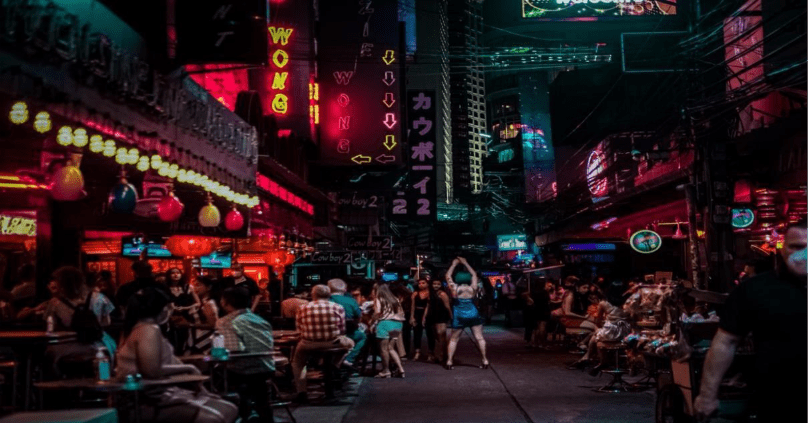
The neon lights of Nana on the red-light district flicker against the humid Bangkok night, casting a relentless pink glow over the street. On the surface, it looks like any other entertainment district with tourists bargaining over beer, music pulsing from open storefronts, and women in high heels ushering men into bars.
But beneath the spectacle lies another reality, one rarely captured in statistics or headlines: a system of modern-day exploitation sustained by poverty and a lack of real choices. In Bangkok’s red-light districts, sex trafficking is a hidden yet pervasive form of modern-day slavery (Reyes).
For many women in these districts, this is not nightlife, it is survival. “Most of them aren’t here because they chose this,” said Dan, NightLight’s manager. “They’re here because they have no other option. They’re supporting parents, children, entire families. They feel it is their duty.”
NightLight, a Bangkok-based NGO, has been operating in this environment for twenty years. NightLight has built trust and offered pathways out of sexual exploitation through three main strategies: relational outreach, alternative employment, and holistic support. They do not storm brothels or stage dramatic rescues, but they employ a more radical approach: patient presence.
Their method is simple. Rather than condemning the women, they sit alongside them. Rather than pulling them off the street, they offer a way out when the women are ready.
“We go into the bars as customers. We’re not there to judge. ” Dan explained. “We buy them non-alcoholic drinks because many women have sales quotas that they have to have customers buy for them anything every month. If we buy them a Coke instead of alcohol, we’re helping protect their health. That’s where trust starts, with something as small as a soda.”
Meeting women where they are
NightLight’s outreach begins not with rescue, but with relationships. Building relationships and earning trust are the most time-consuming part of NightLight’s work.
This is because, exploitation does not begin with a physical act, but rather, it begins with the erosion of self-worth and the belief that no one will help you without taking something in return .

Source: NightLight Bangkok
As Dan explained, “When women have been exploited, sometimes lied to by recruiters, extorted by bar owners, or ignored by police, they learn to protect themselves by never being vulnerable.” In some cases, women have attempted to report abuse or assault, only to be dismissed or threatened with arrest, since prostitution is illegal in Thailand. “It’s just her word against his,” Dan said. “Without objective evidence, most of the time, the police aren’t able to do anything.”
Many women also internalize shame, especially within cultural expectations. For example, in Thai culture, daughters are often expected to financially support their families. Women from rural provinces, often with limited education, come to Bangkok believing they have failed if they do not send money home. When they end up in the sex industry, they may feel trapped between duty and stigma.
This emotional vulnerability is heightended by isolation. “Most women feel they are completely alone,” Dan said. “They believe this is the only path available to them. If you enter that space with judgment, the door shuts immediately.”
These experiences create a deep survival instinct built on self-protection where trust is not easily given and viewed as a risk.
Thus, by approaching women without judgment and with consistent presence, NightLight lays the foundation for dignity and trust.
Every week, female staff enter the red-light districts, sitting at bar tables and speaking softly with women whose lives are governed by quotas, customer demands, and constant uncertainty. The goal is not immediate exit but to regain human dignity.
“It takes time,” Dan acknowledged. “The first time you meet a woman, she’s not going to say, ‘Yes, help me leave.’ But if you keep showing up, without judgment, they begin to open up. They begin to believe they are worth something.”
Trust is further built back at NightLight’s outreach center (located in the Red Light District, just among these bars), where twice a week women can receive free salon services such as hair washing, makeup, coffee, conversation. From the outside, it may look like a beauty parlor. But its purpose is deeper.
“When women come in here,” Dan said, pointing toward the salon chairs, “they are entering one of the few spaces in Bangkok where no one is trying to make money off them. No one is asking them to perform. It’s a place to be seen not as a product, but as a person.”
This experience of dignity is often the first disruption of the internalized belief that exploitation is inevitable. As trust forms, women begin to open up about their circumstance by sharing experiences of withheld pay, unsafe encounters, or coercion, because they finally feel safe to be honest.
They also begin seeking help in moments of crisis, such as pregnancy or violence, and ask questions about employment or housing, signaling a shift from survival to agency. In Dan’s words, trust is the moment “when a woman begins to believe that her life is worth more than the next customer,” and from that belief, the possibility of freedom emerges.
From exploitation to employment
NightLight’s breakthrough came when they stopped asking women to leave the sex trade through outreach alone and instead created a tangible alternative.
“What if we offer them a job?” Dan recalled. “Not charity, employment. Work they could be proud of, with a fair salary, stable hours, benefits, and dignity.”
Today, women are employed by NightLight with stable hours, fair wages, and many benefits. They do craft jewelry, screen-print shirts, sew apparel, and serve in NightLight’s coffee shop.
What makes this model sustainable is that these positions are not temporary. NightLight operates its own jewelry and silk-screening production studio, product display shop, and a coffee shop located just a 5-minute short walk from the red-light district. This strategic location allows the café and shops to attract steady traffic from both tourists and expatriates, generating daily revenue.
Their products are sold directly in NightLight’s coffee shop, showcased at community markets and international schools across Bangkok, featured at pop-up events, exported in bulk to the United States for retail, and supplied to wholesale buyers through large custom orders. These steady income streams allow NightLight to provide long-term employment with reliable salaries.


At the same time, NightLight is structured as a hybrid organization (both a business and a nonprofit) which allows it to support essential services like shelter, counseling, legal assistance, and repatriation through donor funding. According to Dan, “the business covers a significant portion of salaries, but the nonprofit side, supported by individual donors and grants around the world, ensures women also get a future.” This hybrid model ensures that women are not dependent on fluctuating donor’s charity, but are instead supported by a stable, long-term resources that also boost their dignity and growth.
One woman’s story illustrates how this transition can unfold.
She had been working in a bar when she discovered she was pregnant. Her bar manager, concerned for her well-being but unable to offer support, referred her to NightLight. “That only happened because of trust,” Dan explained. “We built a relationship not only with the women, but with the bar owners. They know we’re not there to destroy their business. We’re here to help women who want out.”
NightLight provided the woman with employment, safe housing, medical insurance, and childcare. Her baby now spends each day in NightLight’s childcare center while she works a 9-to-5 job creating jewelry.
“This is what freedom looks like for many of these women,” Dan said. “Not wealth. Just being able to say: today, my body is mine.”
NightLight’s holistic support
Employment serves as a viable exit route, yet some women hesitate due to concerns over lower income or emotional readiness to leave. NightLight recognizes these challenges and provides continuous support to aid their transition.
Years in the sex trade often result in trauma, debt, health issues, and childcare responsibilities, all of which can pull women back into exploitation if left unaddressed. To prevent this, NightLight offers comprehensive services such as childcare, educational scholarships, medical care, counseling, emergency housing, and legal assistance, ensuring that women are not just employed, but fully supported in rebuilding stable, independent lives.
These services do not simply supplement employment, they remove the very barriers, such as illness, lack of childcare, or financial pressure from school fees, that often push women back into exploitation.
As Dan emphasized, “If we offer a job but don’t address the reasons that led her there in the first place, we haven’t really helped her exit. We’ve only delayed the crisis.”
Many of the women NightLight serves are also foreign nationals trafficked under false promises of employment, then smuggled into forced labor or scam operations. “The new trend is forced criminality,” Dan explained. “Women are brought here believing they’ll work in an IT job. Then they end up across the border in Myanmar, forced into scam operations under threats of rape or violence.”
To support these women, NightLight operates one of the few shelters in Thailand legally registered to house foreign trafficking victims, accommodating up to sixteen women at a time. “For international women, our goal is to help them return safely to their home country,” Dan said. “We partner with the International Organization for Migration and with NGOs in their countries of origin. We don’t just send them back, we want to help them rebuild.”
Holistic care is therefore not an optional add-on to NightLight’s mission; it is the only viable path toward permanent freedom through restoring physical health, emotional stability, economic security, and the dignity required to build a new life.
Aligning with reality
Now, some might argue NightLight’s impact is too small to address a global, billion-dollar industry. Dan doesn’t dispute the enormous scale of the problem.
“We’re not trying to solve everything,” he said. “If you try to fix this entire issue as one organization, you’d burn out. But if each of us does our part, and we build partnerships, we can fill the gaps together.”
The question is not whether NightLight can end trafficking in Bangkok, but whether its approach of a slow, personal method grounded in dignity, is one of the few that truly works at the human level.
Dan recalled a moment when a woman who had been trafficked for years was preparing to return to Kenya. “She told us, ‘Now I have a future. I can open a small shop. I am going home with dignity.’ That’s why we do this.”
A quiet transformation
The change happening at NightLight is not loud or sensational. It does not take place through dramatic raids or viral campaigns, but through quiet consistency of sitting in a bar and ordering a Coke, washing women’s hair without expecting anything in return, and offering employment before offering advice.

This work is not about rescue, but restoration. It is the gradual rebuilding of belief that another life is possible, that exploitation is not a destiny, and that freedom is not merely the absence of harm but the presence of dignity.
As Dan described, “For most of the women we work with, freedom means this: my body is mine, not someone else’s. If we can help even one woman reach that point, then our work is not small. It is everything.”
References:
- “NightLight Bangkok | NightLight.” NightLight, 2025, http://www.nightlightinternational.com/nightlight-bangkok.
- Reyes, Cazzie. “History of Prostitution and Sex Trafficking in Thailand – End Slavery Now.” Endslaverynow.org, 8 Oct. 2015, http://www.endslaverynow.org/blog/articles/history-of-prostitution-and-sex-trafficking-in-thailand .
- The 3 Red Light Districts in Bangkok | Thailand Redcat. 20 July 2013, http://www.thailandredcat.com/bangkoks-3-red-light-districts/.
 Youth For SDG