
Authors: Qiaoya (Krystal) Zhang, Guangu (Brian) Hu, Yueyue (Joy) Ma, Yiyang (Sylvia) Sang (in no particular order)
In recent years, national and local governments emphasized the development of rural areas. Various social organizations and government agencies have played an important role in helping farmers improve their economic income. In Kashgar, the development and prosperity of the economy of the rural areas are seen as the key to Kashgar’s overall progress. One of the core tasks of this mission is to increase the income of farmers by supporting them with relevant training and measures.
In Kashgar, many rural families depend on traditional agriculture and livestock for their livelihoods—the lack of modern technology and the ability to receive information acted as an obstacle for these families. Therefore, to effectively promote economic development and improve the quality of life of farmers, various forces are helping farmers master modern agriculture and animal husbandry techniques through a series of training and technical support. This way farmers can achieve sustained income growth.
In addition to that, providing education and training to youth and women in rural areas is also crucial. The local government and social organizations are actively supporting youths to find jobs in other provinces in China, based on their initiatives and thoughts of moving to other places. For those who would like to stay at Kashgar, governments cooperated with organizations that are aiding Xinjiang. Together, they gave the youths and women suitable career trainings and improved their living qualities.
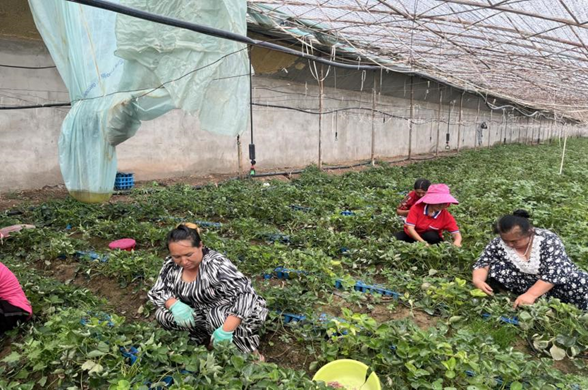
Multi-dimensional agricultural training: Effectively enabling farmers to increase their income.
To promote the development of the rural areas of Kashgar, the Social Work Organization of Shenzhen and Kashgar (SWOSK) – an organization that was established for Shenzhen to aid Xinjiang directly – provided support in many aspects. In means of livelihoods, SWOSK mainly donated livestock and offered methods of keeping livestock. A staff member working at the SWOSK said, “Our main objective is to do public service. Our mission is to serve people and drive the development of the minorities.”
To begin with, the training of trading livestock is vital in increasing farmers’ income. Many families in the rural areas rely on trading livestock for their economic income. Pieces of training can let them identify sheep of high quality and lower the price when buying sheep. This way, farmers can obtain high-quality sheep at a lower cost. After farmers buy the sheep, training courses will teach them how to let sheep breed lambs and then let the lambs become people’s buying targets. Training of this kind can let farmers know how to choose and sell sheep, thereby increasing farmers’ income.
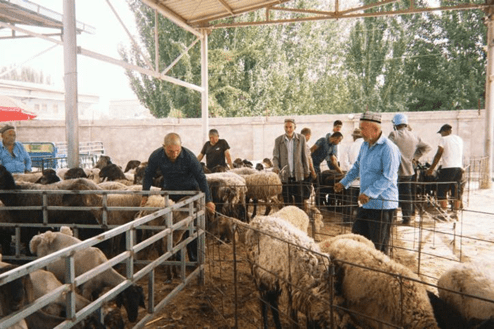
In addition to that, fattening training teaches farmers efficient ways of gaining income and aids farmers in developing a market-oriented mindset. In the past, it took a year for a sheep to grow from 30 kilograms to 50 kilograms. In contrast, fattening training allows farmers to shorten this process to 40 days. Fattening training was followed by training in preventing livestock from being infected by diseases. Preventing disease infection in livestock reduces livestock mortality rates and thus increases the number of livestock available for sale.
Cattle, for instance, are sensitive to weather changes and often get sick when situated in a hot environment. Hence, social organizations set up medicine baths in Yingwustan Township to help animals stay cool in the summer and repel insects in other seasons. More than 80 percent of the 120 households that used the medicine bath thought it was conducive. This measure has been widely recognized and provides a way for farmers to increase their income.
The annual income of Ayixiemuguli’s family in Boshkeranmu Township, Kashgar (also known as “Bo Township”) is 60,000 RMB. Her family’s income mainly relies on fruit cultivation and stock farming. Every winter, the government provides training in fattening cattle and preventing disease infection in livestock. This support helped Ayixiemuguli’s family obtain a steady source of revenue.
The training has also made a big difference in Gulimire’s family. In the past, the main income depended on her mother. Being a seamstress, her mother earns 2 RMB per dress, and her income in the winter is about 2,000 RMB. During the Spring Festival, Gulimire’s mother worked at vegetable greenhouses, earning 60 RMB a day. Last summer, Gulimire’s family received three ewes via the “Sheep Babes” program, run by the Social Work Organization of Shenzhen and Kashgar (SWOSK).
The “Sheep Babes” program not only helped Gulimire’s family but also many other families in need. Since 2011, the “Little Ewe” project (now referred to as the “Sheep Babes” project) has distributed sheep to families in need. After two years of running the project, the sheep produced more and more profit. The number of families helped by the “Sheep Babes” program has increased from 80 at the beginning to 1,661 now. SWOSK has provided more than 9,000 livestock to families in need, helping them get rid of poverty. SWOSK made it possible for the families to have an average of 20,000 RMB increase in each family’s income.

At the same time, training also includes integrating technology with agriculture and developing modern agriculture. Mr. Su from SWOSK stated that the application of drones is very useful in supervising disasters in farmlands, controlling pests, fertilizing crops, weeding farmlands, etc. Vegetable greenhouses in Bo Township Modern Agriculture Industrial Park use modern technology, making agriculture possible despite temperature or weather restrictions. Plus, an automatic irrigation system ensures that crops receive enough water, allowing them to grow faster with better quality.
Gradually becoming in line with the whole country: Youths helping families improve their lives.
Under the leadership and help of the government and various social organizations, youths in Kashgar are gradually becoming in line with relatively developed provinces in China. While many young people have made it into college, they are often lack of information regarding career paths. Xiao Tu – an employee at the Social Work Organization of Shenzhen and Kashgar (SWOSK) – said, “College students in the city have clear career goals following their parents’ plan. However, many college students in the countryside are often at sea, because their parents don’t know about the job market.”
As a result, SWOSK has launched a youth career planning program. The project includes helping juniors and seniors decide which career is suitable for them through a personality test (MBTI), providing opportunities for them to try out jobs, and preparing them for the job market in advance. In addition, the program teaches college students a series of basic knowledge, such as telling them not to borrow money online. Within a year, SWOSK helped nearly 50 college students find suitable jobs. Through this program, these college students now receive relatively high salaries, and the income level of the entire family has significantly increased.
Furthermore, Mr. Wang – secretary of Bo Township the eighteenth village – said that for college students who choose to return to Kashgar, the village committee will help them enter state-owned enterprises or start their businesses. For students who want to get hired by companies, the village committee will tell them specific information, such as the kinds of exams that need to be taken. In addition, the village committee also provide Mandarin courses. Every Tuesday, Thursday, and Saturday, Mandarin lessons are given to help villagers better communicate in Mandarin and increase commercial intercourse with the mainland.

Also, the older generation is becoming more open-minded regarding their view of the world and education. This has promoted the older generation’s children to become in line with the mainland. The boss’s wife of Hehe Jiayuan – a restaurant at Bo Township the eighteenth village – said that she preferred to run the restaurant, rather than be a housewife. Since her eldest daughter is in her sophomore year, she needs a lot of financial support. The boss’s wife is willing to make changes and manage the restaurant for the sake of her child’s future. This reflects the older generation’s support for their kids, allowing them to receive a better education, rather than staying in the village for a lifetime. Because parents do not want their children to go through the same hardships they went through, they often fully bolster their children’s ideas and goals, providing the greatest support possible.
Vocational training: Helping women workers change their mindset.
The education and training given to women workers in industrial parks of Central and South Asia have significantly improved their income and quality of life. To help housewives living in rural areas – most of them are engaged in garment production at home and aged from 35 to 40– increase their incomes, the government encouraged them to receive training and get a job. When the women workers first arrived at the factory, they knew almost nothing about the usage of modern facilities, even the use of toilets was unfamiliar to them. In addition, due to the traditional saying “Men dominate the outside; women dominate the inside”, housework in the past mainly fell on women. This caused women to have very few opportunities to devote themselves to industrialized work away from home.
Thus, Ms. Zhang – director of Xinjiang Haohui Clothing Co., Ltd. provided the women workers with education and training. The women workers began to become proficient in utilizing the modern facilities in the factory. With more adept skills and a changed mindset, their salaries could reach 3,000 RMB.
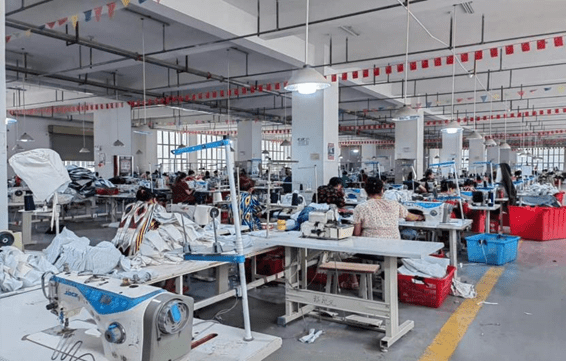
Ms. Zhang said management and training inside the factory are crucial. During Ms. Zhang’s lecture, she emphasized the spirit of self-reliance and self-improvement. She stressed the concept of “women should be self-reliant.” In terms of training, the factory teaches workers a variety of skills. First, women workers learned the basic procedure of garment production, such as threading a needle, knitting a pattern, using a sewing machine, etc. Furthermore, workers can develop their language abilities. All employees are given opportunities to learn Mandarin and use it when working. The factory will also regularly select outstanding employees to visit other enterprises in Shenzhen, exchanging knowledge and information with others. Plus, the industrial park will offer other lessons that regard topics like law, personal safety, child protection, cybersecurity, etc, in order to acquire enhancements in all aspects. Employees are encouraged to learn cutting and design skills online to boost their professionalism. At last, the factory also offers various benefits, such as free lunches, bonuses, and government-funded commutes. Workers undergo a medical check-up every three months, and all healthcare costs are covered by the government.
Conclusion and Takeaways
Multi-dimensional training not only helps farmers increase their income but also improves their overall quality of life. Through training, farmers understand how to trade livestock, fatten animals, and prevent livestock from getting sick. Now, farmers can manage stock farming with efficiency and facility. Aiming at the younger generation, the youths in Kashgar are actively using the resources provided by various government and social organizations to fulfill themselves and achieve their purpose,creating a more prosperous life for both themselves and their families. Vocational training has also played an important role in raising the income and status of women workers. Through training, women workers are not only economically independent but also gain more respect and recognition in their families and society.
 Youth For SDG