By Huimin Tang
Introduction
“The combination of dance and technology creates a new form of art, expanding the understanding of movement and space. For example, virtual reality (VR) creates immersive dance experiences, and makes audiences feel like they are a part of the performance. This technology has brought new frontiers for dance.” This article focuses on how technology development has affected the dance industry, the opportunities and challenges these technologies present for business development. The article is organized into five sections: background and evolution of dance technology, current landscape of the dance technology business, challenges and considerations, case studies, and future directions and opportunities.
Background and Evolution of Dance Technology
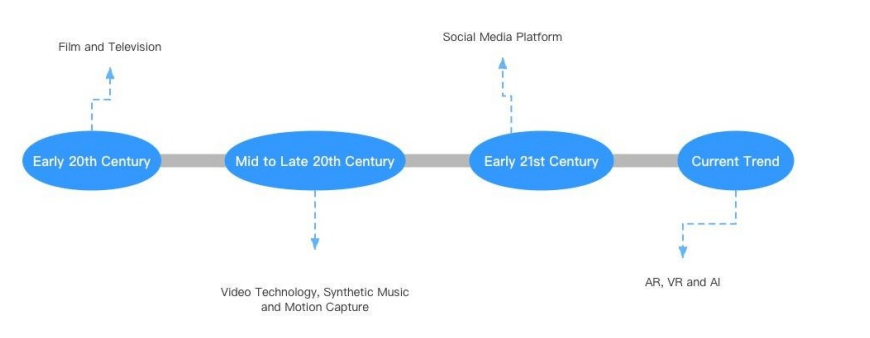
The advent of technology has brought significant progress to the dance industry. Dance technology encompasses modern tools used in dance performance creation and research. The evolution of dance technology can be traced through several key milestones:
- Early 20th Century: Film and television began capturing dance performances, making dance accessible to a broader audience. This marked the beginning of a period when dance documentations will exceed live performances.
- Mid to Late 20th Century: The introduction of video technology and synthetic music
significantly impacted dance. The late 20th century saw the development of interactive technology and the rise of digital platforms, changing how dance was created, shared, and experienced. Video motion capture emerged, allowing for the recording and analysis of dance movements. According to Wu and Lian (2021), “In 1991, a team of researchers and artists from the computer graphics Multimedia Laboratory of Simon Fraser University in Canada developed 3D choreography software, Life Forms. Life Forms uses 3D dancer models to animate and then synthesize dance performances on screen” (p. 5). This development brought new possibilities for the dance industry. - Early 21st Century: Social media platforms enabled dancers to reach global audiences instantly, which made more people get in touch with dance and allowed for a more extensive exchange of ideas and styles. During this period, motion capture technology became more sophisticated and accessible. It would be able to capture detailed body and facial expressions, and profoundly impacting choreography and performance accuracy.
- Current Trends: Today’s trends such as virtual reality (VR), augmented reality (AR), and artificial intelligence (AI) have further diverse the ways in which dance is created, taught, and experienced. VR and AR provide immersive environments for training and performance, while AI aids in generating innovative choreography and analyzing dance movements. These advancements illustrate the significant strides made in integrating technology with dance, enhancing both the creative process and audience engagement.
The impact of technology on dance practice and performance is profound and multiple, assisting in dance creation, teaching, and performance. In a traditional way, dance relied on the expression of the body to tell stories. However, the body is no longer the only medium for dance art with the development of technology. These technologies complement and expand the expressive capabilities of dancers, enabling new forms of storytelling and audience interaction now.
Current Landscape of the Dance Technology Business
The dance technology business is a multifaceted industry spanning various sectors, including hardware, software, online training, and performance enhancement tools. Here’s a comprehensive overview of the current landscape:
Market Overview: The dance technology market is diversity and growing rapidly, encompassing several sub-segments:
- Hardware: The hardware market related to dance includes various technical tools and equipment used in dance studios and performances. This includes production equipment like sound systems, lighting equipment, and video recording tools.
- Software: Editing software such as Final Cut Pro, Isadora, and Animation aids in the postprocessing of dance pieces. Many independent dance studios have developed their own apps for publicity and operation.
- Online Training and Digital Platforms: This market segment grew significantly during the pandemic. Companies like Steezy Studio offer a wide range of online dance training courses accessible to the general public.
- Electronic Dance Music (EDM): The demand for music tailored to dance pieces is growing, leading to advancements in music production, arrangement, and distribution, which significantly influence dance culture.
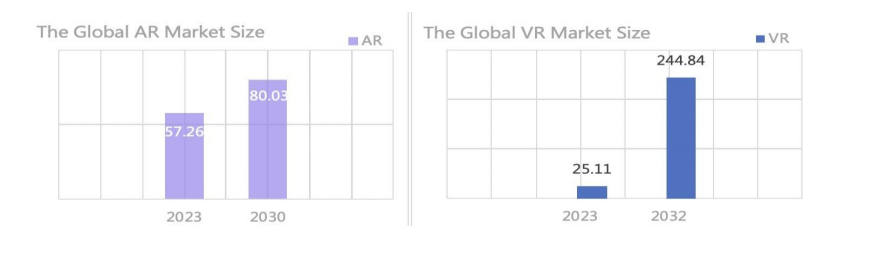
Market Size and Growth: Augmented reality (AR) and virtual reality (VR) markets are significant components of the dance technology landscape. According to Grand View Research, the global AR market size reached $57.26 billion in 2023 and is expected to grow at a CAGR of 39.8% from 2023 to 2030. The global VR market size was $25.11 billion in 2023, and Fortune Business Insights predicts it will grow to $244.84 billion from 2024 to 2032. These figures indicate the substantial impact AR and VR technologies have on the dance industry, offering immersive experiences that enhance both training and performance.
Key Players: Several well-known AR and VR dance companies are pioneering virtual dance training and performances:
- Dance Reality: The founders of Dance Reality created the first AR app to help people learn to dance.The company was established to make dance accessible to everyone using AR, VR, and AI. They use AR technology to teach dance steps, guiding students through virtual characters.

- zSpace: zSpace combines AR and VR in computers, providing technologies for the education market to help teachers and learners interact with virtual objects in a simulated environment.

Product and Service Innovations: Innovations in dance technology have led to the development of various products and services catering to dancers, choreographers, educators, and audiences:
- Wearable Technology: Helps dancers track movements and produce data to detect performance issues. Sensors can control lights based on dancers’ movements.
- Choreography and Motion Capture Software: Enables choreographers to design visually intricate dance performances and educators to provide clear movement breakdowns.
- Virtual and Augmented Reality: Offers new performance formats and educational tools, enhancing choreography and stage effects.
Audience Engagement and Experience:
- Immersive Performances: AR and VR technologies provide immersive dance performances, engaging audiences in a multi-dimensional experience that blurs the lines between performers and the audience.
- Interactive Platforms: These technologies have changed the traditional viewing experience by allowing audiences to interact more directly with performances.
Challenges and Considerations
While technology brings numerous benefits to the dance industry, it also presents several challenges that need to be addressed to ensure its effective integration.
Movement Accuracy: Technology in dance often faces problems with movement accuracy. This problem is inevitable regardless of the technology. At the 2024 Ohio Dance Festival, there were a few pieces that were delayed in lighting and music playback. This affects the sequence of the dancers’ movements, as well as the performance. To avoid this problem, staff need to pay attention to optimizing software and upgrading hardware facilities in a timely manner. Before starting the performance, there should be enough communication and rehearsal with the dancers. For example, hardware facilities such as lighting and sound need to be updated based on the function, and the software needs to wait for the developers to modify and update on time. In addition, the tech staff needs to rehearsal with the dancers to verify each cue before the concert as well.
Hardware Limitations: There are many stage design props required for a dance performance such as lighting, sound, AR and VR etc. The price of these hardware is generally high. Equipment such as lighting and sound can be reused, but equipment like AR and VR is not needed for every performance. Therefore, some devices are not widespread to be used in dance performances. Dance companies can solve such problems by collaboration. They can choose to be partners with tech companies to offer equipment at discounted rates or sponsorship deals. For instance, many technology companies need to test new devices after they develop. Dance companies can use this opportunity to collaborate and gain discounted technologies.
Maintaining Cultural and Artistic Integrity: While modern technology opens new avenues for dance art, it also raises concerns about maintaining the integrity of traditional dance forms and culture. There is a risk that technology might overshadow the cultural and artistic essence of dance. Nowadays, the advent of dancevideos and other methods began to slowly replace the live pattern. For example, many performances start providing online performance. This situation will lead many audiences to give up the in-person performance so that the audience will miss a lot of things. It is essential to use technology to enhance and complement traditional dance rather than replace it. To emphasize the importance of cultural preservation and integrating technological advancements thoughtfully can help in maintaining the balance between innovation and tradition. The national government can step in and sponsor dance companies more live performances. For instance, many local governments in China invite dance companies to perform live during festivals.
Future Directions and Opportunities
The future of dance technology is full of potential, driven by continuous advancements in motion capture, augmented reality (AR), virtual reality (VR), and artificial intelligence (AI). These emerging technologies are set to revolutionize the dance industry, offering new creative possibilities and transforming how dance is practiced, performed, and experienced.
Motion Capture and AI Choreography: Motion capture technology is evolving to become more accessible and sophisticated, which allows for the detailed capture of dancers’ movements. AI is increasingly used to generate innovative choreography, analyze dance movements, and predict trends. Companies like Vicon and Xsens are developing systems that can be used in smaller studios and even at home, making high quality motion analysis available to a broader range of dancers and choreographers.
AR and VR: AR and VR are becoming important to dance training, rehearsals, and performances. These technologies provide immersive environments that simulate any setting, enhancing storytelling and audience engagement. For example, The Royal Ballet has experimented with VR rehearsals, allowing dancers to practice in virtual environments before moving to the actual stage. AR and VR will enable dancers to perform in augmented spaces and offer audiences interactive, immersive viewing experiences globally.
Integration with Digital Media and Streaming: The combination of dance with digital media platforms and streaming services will continue to expand, enabling real-time interaction between performers and audiences. Platforms like DancePlug and CLI Studios are enhancing streaming with interactive features like live feedback from instructors and real-time audience participation. This democratizes access to high- quality dance education and performances, which allows for global participation, and opens new revenue streams through subscriptions, pay-per-view, and virtual ticket sales.
Health and Performance Enhancement: Wearable technology and health monitoring apps are becoming more universal, helping dancers optimize performance and prevent injuries. These technologies provide real-time feedback on dancers’ physical and mental well-being. Devices from companies like Dancer Wellness Project offer comprehensive health monitoring, tracking metrics such as heart rate, muscle fatigue, and hydration levels. By leveraging these tools, dancers can maintain peak performance and extend their careers. Health data can also inform more effective training programs tailored to individual needs.
In conclusion, dance technology has a lot of opportunities to develop in the future. By applying these emerging technologies, the dance industry can continue to innovate, reach new heights of creativity and expand its global impact. The key point will be to balance technological advancements with the preservation of the art form’s cultural and artistic integrity.
Reference:
Satish, S. (2019, April 30). Technology and dance: Blending the digital and Physical Worlds.
Medium.https://medium.com/digital-literacy-for-decision-makers-columbia-b/technology-and-dance-blending-the-digital-and-physical-worlds-33589ff2bdd6
Zhen, W., & Luan, L. (2021). Physical World to Virtual Reality – Motion Capture Technology in dance creation. Journal of Physics: Conference Series, 1828(1), 012097.https://doi.org/10.1088/1742-6596/1828/1/012097Encyclopædia Britannica, inc. (n.d.). Motion capture. Encyclopædia Britannica.https://www.britannica.com/technology/motion-capture
A brief history of motion capture for Computer Character Animation. (n.d.).https://education.siggraph.org/static/HyperGraph/animation/character_animation/motion_capture/history1.htm
Virtual reality [VR] market size, growth, share: Report, 2032. Virtual Reality [VR] Market Size,Growth, Share | Report, 2032. (n.d.).https://www.fortunebusinessinsights.com/industry-reports/virtual-reality-market-101378
Augmented reality market size and share report, 2030. Augmented Reality Market Size And
Share Report, 2030. (n.d.).https://www.grandviewresearch.com/industry-analysis/augmented-reality-market
 Youth For SDG