Shiyang Liu, Jasmine Zhang, Shang Wan, Jingfang Liang, Ran Zhang
“If nobody helps me, my daughter will become the next me.” These are desperate words from a Kibera slum woman.
As the interview progressed, she confided her experiences to us. Kiara was married to an old man at the age of 13. Her 29th birthday was a few weeks ago, but she’s already the mother of 10 kids. Kiara felt like she was falling off a cliff, it had been 16 years, yet she had not reached the ground. Kiara fears her daughter would replicate her life. She didn’t want her to fall off this same cliff.
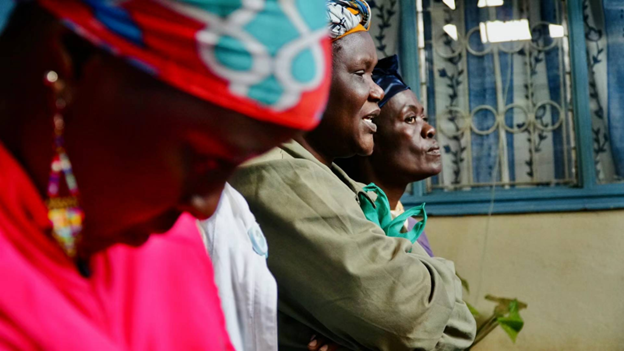
According to the organizer of a women empowerment NGO WYCDO, Terry Mumbi Kiragu, the underlying issue of most Kenyan women’s challenges is poverty.
Kibera, positioned in Kenya’s capital Nairobi’s South Eastern region, is the largest urban slum in Africa. It holds a vast population of 600,000 to 1,200,000. Less than 1% of Nairobi’s land, but contains around one-quarter of its people.
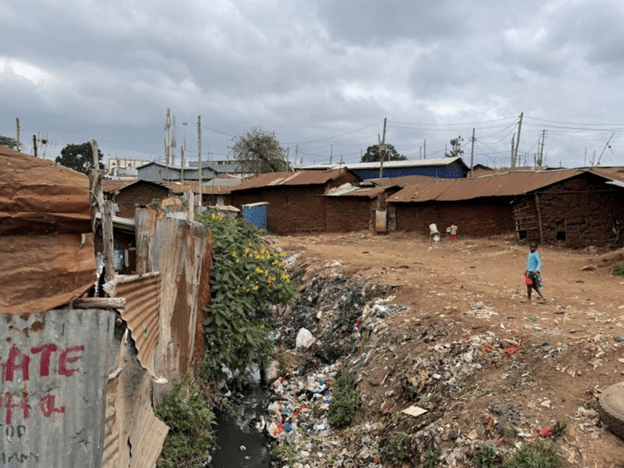
In addition, the unemployment rate in Kibera is over 50%. The average income per week is 565 shillings (4.01 USD), which is way lower than Nairobi’s average income of 16,750 shillings (120.32 USD). Within Kibera, the average income for men is 830 shillings (5.89 USD); whereas the average income for women is 300 shillings (2.13 USD), which is 2.7 times lower than men.
Due to poverty, it is difficult for women to pursue quality education and health care. These women often need to work more than three highly laborious jobs simultaneously. Sometimes they would even be involved in prostitution to survive.
From the health care aspect, “I don’t know a single woman here that can afford her pills.” Says an employee that works for WYCDO.
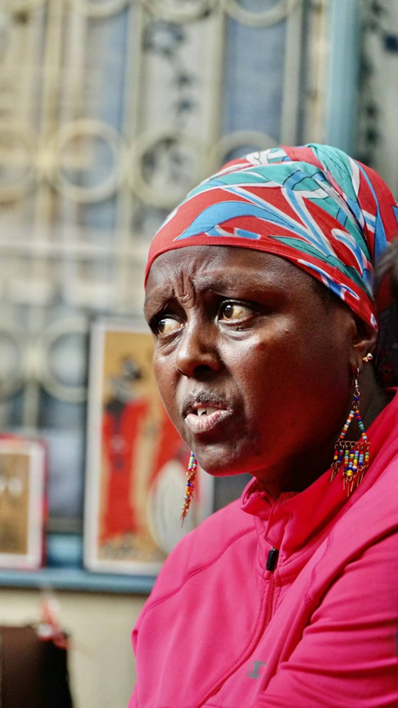
From the education aspect, the average Kenyan male literacy rate is 85%, whereas the average Kenyan female literacy rate is 78.5%. When Terry was asked to comment on education in Kibera, she answered, “It’s not that they don’t want to, but that they are financially incapable.”
To help these women combat poverty and the package that comes with it, many non-government organizations emerge. Women, Youth & Children Development Organization (WYCDO) is a typical example. Founded in 1998, with the ambition and aspiration to increase women’s living standards and provide them with greater chances of receiving education, an NGO that utilizes a banking method called “Table Banking” to overcome poverty issues was established.
What is Table Banking in Kibera?
Most Kibera women lack economic income and remain in poverty status. Moreover, the local cultural and social customs do not promote self-control and finance managing. This resulted in their habit of spending what they had earned by the end of the day. This leaves them in a vulnerable state since they can not afford tuition fees, business, and medical needs.
“The money was gone before I even noticed, ” A woman from Kibera recalled her saving situation before entering the Table Banking group.
For most Kibera women, their income only helps them last through the day and pay rent. A local Kibera woman claims that out of their 300 shillings income, 200 is spent on food, dividing most of the 100 shillings between rent and daily costs. As one can see, there are barely any left by the end of the week.
Without any savings, if they are suddenly confronted with urgent situations, such as medical emergencies, tuition fees, or the passing of a closed one, they have nothing to spare. “And because of their financial and income situation, no bank would be willing to loan them”. Terry claims.
Table Banking was born under this unique circumstance. In simple terms, Table Banking is a group funding system that functions on the basics of depositing and loaning.
Table Banking groups in WYCDO usually consist of 5 to 15 women. Each group functions in its own autocracy strategy. Monitored by a chair, a secretary, and a treasurer. Every group constructs its own regulations, rules, and penalty system.
One of the main attributes of table banking is saving. Each week, during group conferences, every individual in the group deposits a small amount of money, around 50–100 Shillings (0.35—0.7 USD). However, each member’s deposit is stored separately, and will not convene.
“It is like everyone owns their bottle of water, the bottles are collected to form a pile. Though, the refilling and drinking are only performed to your own bottle of water.” Terry explained.
Another one of table banking’s main attributes is loaning. When a member of the group needs money, they would apply for borrowing during weekly meetings with the group. They can only loan from their own bottle, and they may not borrow more than 80% of their savings. “Therefore, even if a member fails to reimburse, it wouldn’t affect other group mates’ savings, and hence they don’t need to take the risk of paying for one another’s mistake”. A WYCDO volunteer explains.
After four weeks, the borrowers are required to reimburse the money they borrowed with a 10% interest. This interest rate is lower than the Kenyan bank interest, and they go back to the women’s own savings. If they cannot return the loan within four weeks, the arrears next month raises, and the charge does to reenter her savings, but instead is split amongst the members. For example, if I borrowed 1000 shillings last month, but I cannot afford to reimburse today. Then I need to come back with 1100 shillings next month (1000 x 10% + charge). They charge usually 50 — 100 chillings. And if I still can’t afford that, the arrears increase to 1210 the month after that.
In summary, there are two main methods of earning profit through this system:
First is compound interest. As mentioned above, if a member is incapable of reimbursing, they are charged by the group, and their arrears is split amongst the group mates.
Other than that, there is another situation in which an individual will be fined by the entire group——If they were unexpectedly absent from weekly meetings. They could face a fine of 200 Shillings, around 1.48 USD.
By the end of the year, every member will get back from the bank what they have saved.
What accomplishments have Table Banking made in Kibera?
The two main contributions Table Banking brings to Kibera women are financial empowerment and mental empowerment.
For financial empowerment, Table Banking displays two main values.
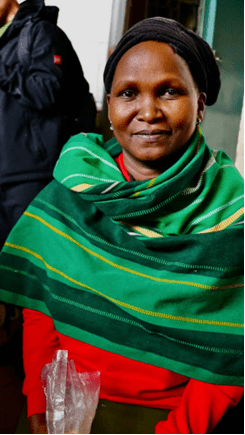
Firstly, to make saving a habit.
A young member of the community claims, “Before enrolling in table banking, I spent every last penny by the end of that day since I didn’t believe 2 shillings could do me any good. But after joining WYCDO, I learned that droplets form the ocean. I was able to use those 2 shillings to start my business and now possess way more than the capital.”
This saving habit enables these women the ability to face financial urgencies, hold on to business opportunities, and increase their income level.
Violet makes a local Kenyan food called Samosa for a living. Under the encouragement of people around her, she decided to investigate the 5000 shillings she saved for over a year into her Samosa business. She was extremely successful by making 17,000 out of the capital, and she was able to open up a larger business.
Violet claims, “Table Banking brought this opportunity to me. The money I have saved in my capital pool opened up a life with possibilities. ”
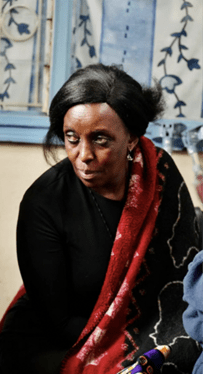
Secondly, it provides Kibera women with business opportunities and resources.
Through creating groups, a network of resources and relationships is spread, later translating into profit for these women.
Maisha Mapya tribe, which means “new life” in Swahili. The group started with 5 people. They collaborated and ran a bead ornament business together. When words of success spread within their tribe, more and more women entered the group and expanded it to the current size of 13 women. At every weekly gathering, they would share pieces of advice and resources, and even invest in one another’s business.
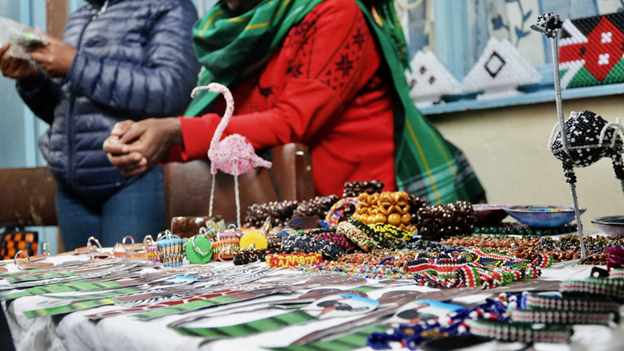
For example, a trolley that belonged to a member named Irene was taken away by the police. This completely terminated Irene’s business. When she was in her vulnerable state, other group members gathered up 6000 shillings from their savings and purchased a new trolley to help Irene back on her feet.
For mental empowerment, Table Banking displays two main values.
First of all, they encourage women to use the loaned money on business, and to make a profit greater than 10% (The interest is 10%), empowering the women mentally to change their fate.
One of the women who joined Table Banking, Mary, told us that her initial intention in attending this program was to store her money so that her alcoholic husband wouldn’t squander it on beer. She did not plan to start a business with that money. Hence, the force loaning policy upset her.
Though she had no other choice but to learn how to start a business, because her financial situation does not allow her to give up that 20%.
Now, she owns a successful snack business. During our interview, she said with bright eyes, “Two years ago I just wanted to survive through the day, but now, I anticipate tomorrow’s sunshine”.
Uncertainty of living transformed into dreams of the future.
Secondly, Table Banking creates social networks and mental support for women in poverty.
“Rather than identifying them as my teammates and friends, I call them my family. I was abused and discarded by my original family, but I have found genuine care from them as a family member.”
Sarah, a woman from Kibera told us, before joining WYCDO, she had to withstand all the challenges and traumas by herself. But after entering the group, she found multiple individuals who she could connect with, they formed a family-like friendship.
“Last month, I lost my eldest son. I was in agony starting from the moment I got the news. But during this period, my Table Banking sisters kept visiting me, praying for my son and me, and bringing us expensive food and necessities. If it weren’t for the Table Banking group, if it weren’t for these sisters, I don’t know whether or not I would have made it past this dark period.” Sarah said.
There are too many similar stories in WYCDO. Life has stabbed them countless times, leaving a bloody mark each time. As resilient as they were, traveling across the desert for days and nights, they finally reached the oasis. There she met a group of strong women, she took off her shield and blended into the group.
However, even though the Table Banking system brings women in poverty many benefits, there are objective issues in the operation process.
Table Banking’s challenge is that the money deposited is inadequate for enriching or largely altering these women’s living conditions.
Since minimum capital is invested and only 80% of the money can be borrowed. Women in poverty with low income cannot receive high interest or income. Therefore, the act of depositing in the Table banking system is more like a way of saving the poverty with poverty. The advantages women gained are insufficient for supporting their lives completely.
A decent start-up capital is what they need.
Recently, China House is planning to cooperate with WYCDO to promote ‘The Liberty Station Fund”. China House’s vision is to gather a fund of at least 2000 USD. The fund will adopt a similar system to the Table Banking system, the interest is still 10% of the loan.

Firstly, “The Liberty Station Fund” is able to offer women a larger pool, allowing them to solve emergencies when facing problems.
Secondly, this 2000 USD may become a business-starting fund, encouraging women in poverty to accept businesses with potential higher paybacks.
If the operation succeeded, it would benefit them to a great extent. José, a staff at WYCDO commented in excitement:” This is going to be a movement that changes these women’s life path for good.”
Work Cited
CEICdata.com. “Kenya Average Wage Earnings.” Ceicdata.com, CEICdata.com, 23 Aug. 2022,
http://www.ceicdata.com/en/kenya/average-wage-earnings-by-sector-and-industry-international
-standard-of-industrial-classification-rev-4/average-wage-earnings. Accessed 7 July 2023.
“Kenya: Adult Literacy by Gender.” Statista,
http://www.statista.com/statistics/1233494/adult-literacy-rate-in-kenya-by-gender/.
Saiesha. “Poverty and Inequality in the Kibera Slum – the Borgen Project.” The Borgen Project,
13 Aug. 2022, borgenproject.org/kibera-slum. Accessed 7 July 2023.
Wikipedia Contributors. “Kibera.” Wikipedia, Wikimedia Foundation, 9 May 2023,
en.wikipedia.org/wiki/Kibera. Accessed 7 July 2023.
 Youth For SDG