By Maggie Feng, Jessie Lyu, Yina Li, Andrew Chen
In Lukou Village on the plains of Xinyi, Jiangsu Province, Grameen China staff visiting farmhouses encountered a familiar pattern. They came to speak with women, to hear their stories and introduce a microfinance program that could reshape a family’s economic future. Yet male relatives often intervened.
“She doesn’t understand loans. She knows nothing about these things! If you need to discuss anything, talk to me.”
Despite women’s indispensable contributions to both productive and household labor, their work often remains invisible within formal economic and institutional structures. Their voices are excluded from major family decisions, their names absent from loan documents. As one Grameen manager observed, some women internalize this marginalization: “I don’t understand these things; let my husband decide.”
Gender scholars identify this “invisibility” as a dual constraint: it denies women not only financial resources but also agency and self-definition. Identity is not merely an internal psychological state but emerges through social relationships, institutional recognition, and daily practice. How a woman sees herself reflects how society values her. Autonomy, meanwhile, encompasses the capacity to make decisions, control resources, and act independently despite structural gender constraints.
Simone de Beauvoir famously declared in The Second Sex: “One is not born, but rather becomes, a woman.” This insight reveals that women’s identities and capacities for self-determination are not biologically fixed but socially constructed and therefore open to reconstruction.
Grameen Bank does more than provide loans. Through deliberate institutional practices, it rebuilds rural women’s sense of self and autonomy. The bank helps women transition from dependents to decision-makers through three interconnected mechanisms: institutional recognition, repeated practice, and collective support.
Institutional Recognition—Becoming Visible in Formal Systems
Grameen Bank’s model rests on a simple yet radical principle: women are the sole borrowers. Traditionally, women’s economic labor has been subsumed under male household authority, rendering them invisible as independent economic actors and effectively uncreditworthy in formal financial systems.
In many countries, formal credit remained accessible only to men. Grameen dismantled this barrier through institutional recognition by requiring that borrowers be women and establishing their creditworthiness through five-person mutual support groups rather than collateral.
The rationale is both practical and strategic. Women tend to invest more of their income in family welfare and children’s education, and prioritize community relationships more than men. By lending exclusively to women, Grameen transforms this pattern into institutionally recognized economic agency.
Ms. Ding from Lukou Village, Jiangsu, was among Grameen China’s first members. In 2014, she borrowed 20,000 yuan to launch her pancake business.
“I used to make pancakes by hand. I’d watch others with machines and think, ‘Where could I possibly get the money for that?'” she recalled.
The loan brought more than startup capital. It brought institutional recognition. She was no longer simply “someone’s wife” or “someone’s mother” but an independent economic actor with decision-making authority.
“In our family, I manage the money now,” Ms. Ding said, her pride evident as she described holding the household’s financial reins.
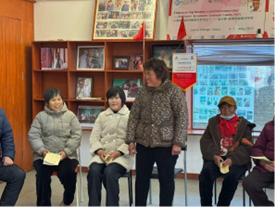
As Gao Zhan, President of Grameen China, explained: “In Bangladesh, men could once divorce women by simply shouting it in the street. Grameen counters this vulnerability through economic empowerment. Loan contracts signed by women establish exclusive ownership of legally recognized assets that cannot be easily stripped away.”
Repeated Practice—Cultivating Control Through Action
Real autonomy emerges from control over resources, from everyday decisions about how money is used, who makes choices, and who bears responsibility.
Ms. Ding used her first loan to buy a tricycle and pancake-making equipment. “Before, my husband decided what to buy and what we’d sell. Now I borrow the money, so I decide how to use it.”
Grameen builds this capacity through simple, repetitive practices centered on a shared goal. Members attend weekly center meetings to track business progress, participate in group discussions, and meet repayment obligations. With repayment rates consistently around 95.55% (as of November 2025), these meetings function as more than administrative checkpoints. They create sustained engagement and accountability.
Making timely repayments isn’t merely a financial obligation; it’s practice in resource management. When women routinely set aside funds for repayments and plan their income allocation, they develop active control over cash flow. This hands-on experience reshapes household power dynamics: who decides spending priorities, who bears economic consequences, who participates in financial decisions.
Even seemingly minor routines carry weight. At each meeting, women sign their names in attendance books, a quiet declaration of presence and ownership. *I am here. This is my account.* Over time, these repeated institutional practices help women internalize a new self-concept: not dependents, but individuals with authority over their economic lives.
This transformation surfaces in members’ own words. Ms. Liu Ruixiang from Lukou Village stated matter-of-factly: “He spends his money, and I spend mine.” The statement reflects a clear progression from institutional structure to internalized autonomy. What begins as compliance with loan requirements gradually becomes confidence in one’s capacity to act independently. Autonomy no longer resides solely in external systems; it takes root within the women themselves, shaping decisions at home, in business, and throughout the community.
Collective Support—Finding Strength in Community
Grameen doesn’t leave women to navigate the market alone. Instead, it embeds individual action within a collective framework through five-person groups and center meetings. Here, women learn not only “I can do it” but “We can do it together.”
These five-person groups function as more than repayment mechanisms; they dismantle social isolation. In many rural communities, women’s marginalization stems not only from lack of economic resources but also from absence of social support networks.
Wang Yanqiu’s journey illustrates this transformation. At 28, she married while working in Xiamen, cycling through demanding jobs: handicrafts, sewing, online customer service, often working 18-hour days. In 2010, breast cancer forced her to stop working entirely. “For five years, my husband supported the family alone as a welder,” she recalled. “I felt we were struggling, and I was worthless. I didn’t talk to anyone in the village. I was afraid they’d look down on me.”
The turning point came when she joined Grameen. Group members suggested she try raising rabbits. But the more significant shift wasn’t the enterprise itself. It was finding a community to lean on.
“Our group of five constantly helps each other,” Wang Yanqiu explained. “Another member who raises rabbits taught me everything: how to handle newborn kits, how to manage feeding. When rabbit feed bags were too heavy to lift, group members helped without hesitation.”
This collective support directly addressed her isolation. Through weekly center meetings, Grameen brings women from the same area together to repay loans, share experiences, and encourage one another. These regular gatherings reduce social distance, build trust, and forge collective identity.
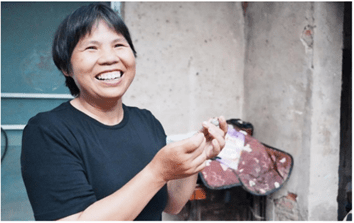
When asked about her biggest change, Wang Yanqiu smiled: “I’ve become so much more outgoing! I used to be reluctant to talk, afraid to engage with people. Now I greet everyone I see.”
Later, Wang Yanqiu became a group leader. Recalling how she influenced others in this role, her eyes lit up: “One member, when she first joined, never spoke. If someone tried talking to her, she’d just smile. After I became leader, I made a point of chatting with her, pulling her aside whenever I had time. Gradually, she changed too. Now she greets me first!”
At Grameen, women don’t face challenges alone. Supported by peers, encouraged through shared routines, backed by collective accountability, their empowerment unfolds not as solitary struggle but as social transformation.
Self-Reconstruction—From Object to Subject
Wang Yanqiu once felt ashamed of her family’s financial struggles and avoided social contact. Today, she directs a Grameen Member Center with confidence and composure. Her transformation stems not only from financial support but from what the system taught her: self-acceptance and self-worth.
Grameen’s true achievement lies in reconstructing rural women’s identity and autonomy through three interconnected mechanisms. Institutional recognition makes women visible within formal economic systems for the first time. Repeated practice (weekly repayments, signed documents, collective rituals) cultivates control through simple, consistent actions. Collective support embeds individual agency within peer networks. Together, these mechanisms accomplish more than poverty alleviation. They enable women’s growth from passive objects to active subjects.
Yet the Grameen model also reveals that institutional innovation is only a starting point. Genuine transformation requires sustained effort across generations.
How can we instill in rural girls from childhood the conviction that “I can do this too”? How can the next generation inherit self-determination and agency as birthright rather than hard-won achievement? This demands more than programs like Grameen. It requires systemic change across education, culture, and law that ensures every woman enters adulthood already seen, already valued, already autonomous.
 Youth For SDG