Authors: Rebecca Xu, Yinglu Shi, Yiran Zhao
Data on gender gaps in income, promotions and entrepreneurship show that women often need to put in two to three times more effort than men to achieve the same level of success. One essential path toward gender equality is economic empowerment, yet how to help women achieve sustainable economic development remains a major global challenge.
When Perry, a woman entrepreneur in the United States, co-founded a restaurant, she knew that even with official approval her loan terms would be far less favourable than those offered to male applicants. She admitted, “I had to repeatedly prove our decades of experience and background, but I know some restaurants never have to do this. To be honest, it is simply because our gender and skin colour are different.”
Research confirms that women owned businesses face higher loan interest rates and are more likely to be required to provide guarantors. Even though the gender rights gap has narrowed in recent years, women still have a long way to go before they can achieve sustainable development.
Through its distinctive institutional design, Grameen places women at the center of its services and advances gender equality both economically and socially. The Grameen Bank’s “five-member group” model organises borrowers into groups of five who monitor each other’s repayments. Members attend weekly center meetings, where financial literacy training is provided through small group sessions. These meetings also create a supportive community that fosters women’s growth and helps cultivate rural female leaders. This model not only supports women in achieving economic independence and inner confidence, but also increases their influence in family decisions, becoming a powerful practice for helping women escape poverty and move toward equality.
Women’s Equality: The Ideal and Reality
Women’s equality means that in both family and society, women and men should enjoy the same respect and the same opportunities. These opportunities include equal access to education, employment, political participation and the distribution of household resources.
In China, women’s rights have achieved historic breakthroughs in higher education, and this progress has extended from the undergraduate level to the training of high level talent. Data from 2023 show that women accounted for 51 percent of all graduate students nationwide, marking the first time that women became the “majority” in advanced academic study. Women now make up 42 percent of all PhD students, a five percentage point increase over the past decade. This reflects unprecedented opportunities for women in both the breadth of higher education access and the depth of high level academic development.
A 2022 report on women’s employment in digital platform industries, jointly released by the Yuhang District Women’s Federation, EO Intelligence and Jingling Group, highlights women’s rapidly expanding influence in the economy through both consumption and careers. According to the report, China’s female consumer market exceeds 10 trillion yuan and spans health, beauty, apparel and education, making women a core driver of economic growth. The report also notes that women are advancing particularly quickly in flexible, creativity driven knowledge sectors. In the digital industry, for example, women make up 80 percent of participants and are the dominant force. Women are no longer only consumers but increasingly builders and leaders of the new economy, marking a shift from large scale participation to high quality involvement.
However, many women still face limited decision making power at home and an undervaluation of their own abilities.
A study published in August 2024 in [World Economic Research] shows that in some parts of China, long-standing rural traditions sustain patriarchal norms. Women’s decision making power in the household varies depending on the matter at hand. Women have relatively greater influence over daily chores, but in major decisions such as family investments or loans, their decision-making power is significantly lower.
| Types of Household Matters | No Decision making power | Rarely decides | Occasionally decides | Usually decides | Full decision making power |
| Deciding daily household expenses | 5.8% | 31.1% | 56% | 7% | |
| Deciding whether to have children | 32.3% | 42% | 24.9% | 0.8% | |
| Deciding the child’s education and career path | 39.3% | 39.3% | 21.4% | ||
| Deciding whether to buy a car | 40.5% | 44% | 15.6% | ||
| Deciding which school the child should attend | 33.5% | 42% | 24.5% | ||
| Deciding on family investments and loans | 61.5% | 28% | 10.5% | ||
| Deciding the husband’s job | 10.1% | 61.1% | 25.3% | 3.5% | |
| Deciding the home’s interior arrangements | 5.8% | 30% | 52.5% | 11.7% | |
| Deciding which family to visit for New Year’s Eve dinner | 12.1% | 50.8% | 34.3% | 2.8% |
In Lukou Village in Jiangsu Province, women are often deprived of a voice within their families. “When we invited an auntie to attend a Grameen Bank meeting, the first person to refuse wasn’t her, it was her daughter. The daughter said the auntie didn’t understand anything. Her husband also used belittling language to describe her,” shared Manager Zhu from Grameen China. The daughter’s reaction was actually an unconscious reflection of her father’s influence. This scene reveals not only the difficult situation faced by rural women, but also how gender inequality is passed down across generations, shaping women’s self perception and limiting their participation in society.
Grameen’s Economic Empowerment: Enabling Women to Earn and Advance
The Grameen Bank in Bangladesh is dedicated to helping women lift themselves out of poverty. One of its core designs is the five member group model, which supports women’s long term poverty alleviation by lowering loan barriers, strengthening their repayment capacity and promoting mandatory savings.
The first major feature of the five member model is lowering the threshold for obtaining loans. Instead of requiring collateral, the system relies on a structure of “five member groups + weekly meetings + membership codes of conduct,” providing women with convenient access to capital. In 2019, Grameen China implemented its inclusive finance program in places like Shenzhen and Lankao. Ms. Habao Feng, in her sixties, had been repeatedly denied loans by traditional banks because of her age. After completing five days of specialised training and forming a five member mutual support group, she successfully obtained start up funds. This example demonstrates how the five member model breaks the rigid traditional requirements for age and collateral, enabling women who were once excluded from financial services to obtain essential funds for starting a business.
The second core feature of the model is strengthening women’s repayment ability. Through weekly repayments and peer to peer exchange of experience, women improve their business skills and reduce financial risks.
During weekly center meetings, members share low cost supply channels and information about sales opportunities. At Grameen China’s Longchi Center in Xuzhou, both Ms. Sun and Ms. Yan worked in pig farming. When African swine fever hit, Ms. Yan used her Grameen loan to restock and made a profit, while Ms. Sun suffered heavy losses due to lack of experience. At the center meetings, Ms. Yan helped her obtain supplies and shared strategies for managing market risks, enabling Ms. Sun to restore her business. This exchange of experience turns the five member group into a small classroom, effectively strengthening women’s ability to handle operational difficulties and repay loans on time.
The third feature of the model is mandatory savings, which helps women develop saving habits and prevents them from falling back into poverty. At the weekly center meetings, all loan disbursements, repayment records and savings details are openly displayed. When making repayments, each member also deposits a small amount of savings, such as ten yuan per week, to prepare for emergencies and unexpected expenses. This transparency builds trust in how funds are used and helps women create financial buffers, effectively reducing the risk of returning to poverty.
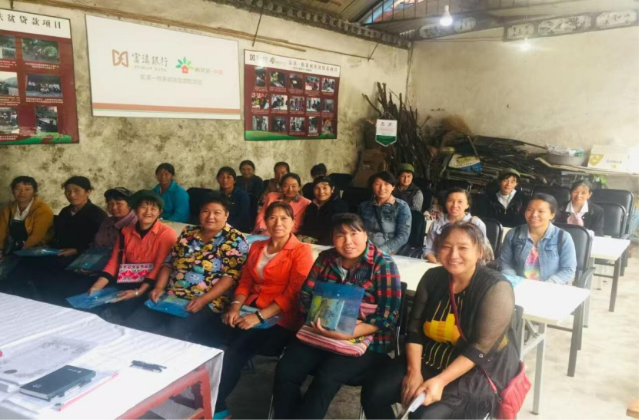
The stable income generated through the five member model not only provides women with a safeguard against poverty but also directly strengthens their status within the family and awakens a deeper sense of self-worth.
Grameen staff noted that once women begin earning more, the first visible change is a rise in confidence. They start setting aside part of their income for themselves, buying jewellery, clothes or cosmetics. They also pay more attention to their health, seeking acupuncture, massage or beauty treatments at wellness centres. These personal needs, once pushed aside under the pressure of “family expenses first,” finally receive attention, bringing noticeable changes to women’s demeanour and outlook.
One Grameen member, Ms. Wang, shared, “Before, the family money only covered daily necessities, so I never had the heart to think about myself. Now that I earn my own money, I’ve started taking care of myself and my child, and I’m even willing to buy clothes for myself.” This willingness to invest in herself reflects a meaningful shift in her sense of self-value.
Non Economic Empowerment Under the Grameen Model: Strengthening Women’s Social Standing
Beyond economic support, Grameen also promotes non economic empowerment through the five member group model and weekly meeting system, especially by expanding women’s social networks. These social ties are not just simple friendships but sources of resources, emotional support and psychological strength that help women gradually gain more voice in both their families and communities.
Through mutual trust and encouragement, the five member groups help women break through self doubt and take their first steps into social life. Many women initially feel “I’m not capable,” but as they watch others improve their lives through their own efforts, and as group members cheer each other on, they slowly become willing to try new things. Some who were once too shy to speak to strangers begin confidently selling handmade products in town. In Grameen’s entrepreneurship program in Ankang, Shaanxi, women dress in their best clothes when attending meetings or cooperative activities. Whether they socialise more boldly or gradually discover their own beauty, these changes reflect rising self esteem and a more positive integration into social life.
The weekly center meetings provide a platform for women to broaden their social circles and receive social support. Poor women who once stayed home for household duties had little chance to make friends and could only carry their burdens alone. In these weekly meetings, they can express frustrations, feel heard and receive empathy and encouragement from other members. They no longer feel they are “struggling alone.” Their mindset becomes steadier, and they gain the strength to face life’s difficulties. These “weak ties” formed through meetings extend women’s social networks beyond family members to wider community members, helping them gradually step out of the small family sphere.
These expanded networks help elevate women’s status. On one hand, they provide emotional support that reduces isolation. When a member faces resistance at home or economic hardship, others actively offer support, encouragement and help. Ms. Wang, a Grameen member, struggled with anxiety during her child’s adolescence, and it was through sharing with group members and staff and receiving ongoing encouragement that she eventually worked through her worries.
On the other hand, these networks give women the confidence to voice their opinions and pursue their own development. When a woman considers starting a new business, she often finds little support at home. In such cases, if she raises the issue at a group meeting, Grameen staff and members will suggest bringing her family next time. Through success stories and shared experiences, they help women influence their family members and secure their support, making it easier for them to pursue independent development.
The Grameen Model: Advancing Women’s Equality Through Institutional Design
With the five member group at its core, the Grameen model has made women’s equal rights a reality through concrete institutional design.
First, the system lays the foundation for gender equality through economic empowerment. It lowers loan thresholds so that women previously excluded from financial services can access start-up capital. It also reduces loan risks through shared resources and mutual support within the five member groups, helping women achieve economic independence. In Grameen’s U.S. program, for example, member Lorena used 1,400 dollars in 2014 to open a small grocery shop and has since expanded it into a mini supermarket, an emblematic case of economic empowerment.
This economic empowerment has also elevated women’s status at home and strengthened their sense of self worth. “Women’s role in the family is very important. Raising children, farming, social relationships and daily responsibilities have always depended heavily on women,” a rural Grameen member in China told us.
At the same time, the Grameen system provides women with non economic empowerment. It expands their social networks, giving them a second support system beyond their households. In this space, women participate as equals, build skills, and gain emotional and practical support, which helps them speak up for their own development and become key decision makers in both family economic matters and community affairs.
Through institutional design, Grameen places real opportunities in front of women, allowing them to gradually claim equal rights. Its practice shows that institutions can be powerful tools for advancing gender equality and offers valuable lessons for gender-equality efforts in other regions.
Reference:
- 国晓丽. (2024). 新时代女性家庭决策赋权及其家庭经济贡献度探究. World Economic Research, 13, 480.
 Youth For SDG